


Welcome to the Carbide Processors Blog
Dissolving Braze Alloy with Acid
Posted on Wednesday, January 2nd, 2013 at 3:35 pm.
Dissolving braze alloys with acid is very dangerous and must be done with extreme caution.
Note: I have a lot of chemistry in both high school and college. I have a chemistry lab at work with a dedicated fume hood. I have even been granted a couple of processes for chemical patents. Having said all this, I would much rather grind braze alloy off a part with a Dremel tool than use acid.
I find that a Dremel tool, with the little cutting disks on it, does a pretty good job of cutting off or grinding off braze alloy.
However the question was about using acid to remove braze alloy.
WARNING: braze alloy is designed to be highly corrosion resistant. To dissolve it you need very strong acids.
- The acids required to dissolve braze alloy will burn you readily.
- These acids will generate fumes as you pour them.
- You must pour the acids very, very slowly and carefully into the water. If you pour the acid in too fast it will bump or flash boil and spray acid into your face.
- When you pour the acid mixture over the braze alloy you will generate very strong fumes that will eat your lungs. If you get a whiff of them they will start eating the nice, soft skin inside your nose and mouth. You’ll be able to feel them eating at you for an hour or so
(I know everybody warned you about everything just to cover their rear ends and most of it is nonsense but this stuff really is dangerous.)
These acids are more likely to dissolve steel than braze alloy. I’ve tried using acid to clean up saw blades and other tools before I analyze them. Typically the steel dissolves first.
All my experiences been with the high silver braze alloys somewhere around the 40 to 60% range.
If I have to dissolve braze alloys with acid I use a 50% nitric acid and water mixture. Be very, very, very careful how you mix this. Very slowly and gently pour the concentrated nitric acid into the water. It is often suggested that you put a glass rod into the water and gently pour the acid down the rod. The rod will also help keep the water from boiling up.
When you pour the 50% nitric acid mixture over the parts it will create fumes. Do this someplace with excellent ventilation. Ideally you will have a dedicated fume hood as I do in the lab. You can do this outside but you really have to watch out for breezes and shifts in the wind.
When you get done dissolving the braze alloy you will have some really nasty liquid waste and you will have to figure out how to dispose of that. You definitely do not want pour it down into a septic tank. And you really better check with your sewer utility department before you pour it down the drain.
There is another mixture called Aqua Regia. Aqua Regia is Latin for Royal water and it has this name because it dissolves the royal metals which are gold and silver.
To make Aqua Regia you mix three parts concentrated nitric acid with one part concentrated hydrochloric acid. Sometimes people will try and sell you muriatic acid telling you it is the same thing as H hydrochloric acid. This may or may not be true.
If you’re going to use Aqua Regia you must use a fresh mixture.
The chemical process by which metals are dissolved involves the acid reacting with the metals and forming a salt. This salt forms a layer over the metals and prevents the acid from getting to the underlying metal.
You are only going to be able to dissolve so much metal before you have to take the parts out and remove the salt layer by sandblasting or something similar.
Torch Brazing with Hydrogen
Posted on Friday, December 28th, 2012 at 9:13 am.
I was recently asked about torch brazing with hydrogen, and why I don’t use hydrogen for brazing. The main reason I choose not to torch braze with hydrogen is because of the safety issues. I use a larger torch, and I don’t like using hydrogen for brazing because I cannot see the flame. Also, hydrogen molecules are extremely small, and can leak out of joints and even through some material fairly readily.
A dangerous amount of hydrogen can easily go undetected. In theory, I could have enough hydrogen leak out of the tank overnight to create a very big safety hazard in the morning, and not even notice or realize that it had happened upon entering the building.
In no way at all am I disparaging hydrogen for brazing or the people that use it. I just do not believe that is fits in my operation. Brazing with hydrogen can be a very advantageous depending on the persons operation or set up. In fact, hydrogen is widely used as a brazing gas by jewelers. The biggest advantage for using hydrogen in this application is that hydrogen is a very clean gas. It can even be said to clean as it burns. Jewelers use a much smaller torch, making the safety risks much more minimal.
Wera Hand Tools
Posted on Thursday, December 27th, 2012 at 1:54 pm.
Wera hand tools are manufactured for professionals for use in industrial applications. Wera has spent decades turning ideas into innovative new solutions in the screwdriving world. From there diamond tipped bits, to their kraftform screwdrivers with ergonomic handles, Wera has made it their job to make your job easier.
Here are some of Wera’s top rated tools that helped to earn them recognition and several awards as innovators in the hand tool business.
The Joker Wrench:
Wera’s Joker Wrench is a ratcheting combination wrench with a unique holding function that reduces the risk of dropping nuts and bolts and prevents slipping. It has a return angle of only 30 deg at the open end to avoid time consuming flipping of the wrench during fastening jobs.
Kraftform Screwdrivers:
Wera’s Kraftform screwdriver is uniquely designed to give you the highest amount of torque, while maintiaining the highest level of comfort. With it’s hard and soft zones, and unique shape, it makes any screwdriving task much more bearable.
Zyklop Ratchet:
The Zyklop Ratchet’s unique design has earned Wera the IF Product Design award for 2009 and the Red Dot Design Award in 2010. Wera’s Zyklop Ratchet combines a Fine-Tooth Ratchet, a Flex-Head Ratchet, an Angle Ratchet, Quick-Release Ratchet, Power Ratchet, and even has a screwdriver function.
The Rapidaptor:
The Rapidaptor is Wera’s compact multi-function tool. The Rapidaptor offers easily inserted and self-locking bits. There are no extra tools needed to remove the bits, and even small bits can be changed easily. The Wera Rapidaptor also features a Free-spinning outer sleeve that stabilizes the electric screwdriver during fastening.
The Koloss:
The Koloss is Wera’s ratchet with a hammer. The Koloss is specially designed to be able to take any blow without damaging or harming the ratchet head.
BiTorsion Bits:
Wera’s BiTorsion bits are designed for greater durability. They have gone through a special tempering process to reduce the hardness of the shaft by about 20% compared to the drive end. This allows the torsion zone to cushion higher impacts. There is also a torsion spring integrated into the BiTorsion holder to cushion smaller impacts.
Impaktor Bits:
Wera’s Impaktor technology ensures a long tool life, even under the most demanding conditions. Wera’s Impaktor bits are designed to be used with conventional impact drivers.
Tungsten Carbide and Magnetism
Posted on Wednesday, December 26th, 2012 at 12:22 pm.
What is most commonly referred to as tungsten carbide is actually tungsten carbide grains cemented together with another metal material. The metal that cements or binds the tungsten carbide grains is typically cobalt. Nickel, nickel-chrome alloys, and iron can also be common binders for tungsten carbide grains.
Every element in tungsten carbide is susceptible to magnetism. Some of the elements are far less susceptible than others. Iron is much more susceptible to magnetism than cobalt, and cobalt is more susceptible than nickel. Tungsten, by itself, has very, very little susceptibility to magnetism. Different grades of tungsten carbide have different amounts of binder in them. The type and amount of each metal that make up the tungsten carbide determines how magnetically responsive the tungsten carbide will be.
By choosing a grade of tungsten carbide that is made up of a very small amount of binder can help ensure that the tungsten carbide is less responsive to magnets. If you need a material that will not react to a magnet at all, tungsten carbide may not be the best choice.
How to Choose Wood
Posted on Friday, December 14th, 2012 at 4:02 pm.
A piece of wood that warps, bows, cups or twists can ruin a project. If the wood dries unevenly, it can cause uneven shrinkage or swelling. Being aware of what may cause the wood to shrink or swell unevenly can help save your woodworking projects. There are some ways to avoid or help reduce the chances of your wood warping, bowing or twisting.
Plywood or other manufactured wood is far less likely to shrink or swell as a result of too much moisture in wood. It can be a good alternative if you want to avoid the possibility of uneven moisture related movement of your project wood.
If you plan on using hard or soft wood, you can still do things to help reduce the chances of your Lumber being ruined from uneven shrinking or swelling. It helps to understand why the wood does this in the first place.
What causes uneven shrinkage in wood stock:
Before a tree is cut down for lumber, the wood is basically a series of thin tubes that bring sap and fluids from the tree’s roots to the upper branches. There is more sap and fluid being brought up through the wood in the outer parts of the tree trunk than toward the center. Lumber that is cut from the heartwood (the wood closest to the center of the tree) is less likely to shrink or swell than the wood that is cut from the sapwood (wood from the outer portion of the tree trunk).
This means that the wood cut from the heartwood will be far less likely to shrink or swell than the Sapwood because the heartwood is less likely to retain moisture.
Shrinkage differs based on the dimensions of the wood:
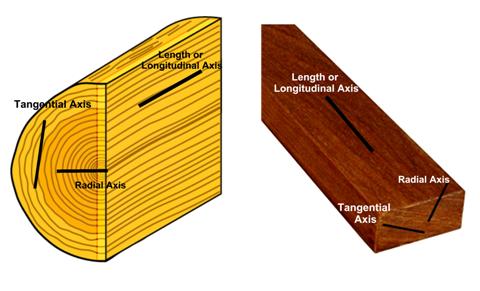
The shrinkage along the length of the lumber is far less than the shrinkage along the radius axis or tangential axis of the wood stock. If you are looking at the end grain of the wood, the radius is the direction perpendicular to the growth rings and the tangent is parallel to the growth rings. The greatest shrinkage almost always occurs along the tangential axis of the wood stock. You can sort of guess whether the board will cup, twist or bow based on the direction of the growth rings on the grain and by how much or if the tangential movement exceeds the radial movement.
Reducing shrinkage by acclimating the wood:
Wood definitely needs to be dried properly before using it for any woodworking project, but it can also make a big difference to allow the wood to be acclimated to the environment the finished project will be in. For example, if the wood stock comes from a very humid environment, removing it from that environment and using it to build a project in a very dry climate can cause additional shrinkage in the wood and greatly affect your finished work.
If you purchase the wood and store it in the location where your finished project will be before beginning your project, it can greatly reduce the chances of the wood shrinking or swelling after the project is completed.
About.com Tip “Movement is one of the many reasons why quarter-sawn lumber is so sought after (and expensive). Because of the way quarter-sawn wood is hewn from a log, the growth rings are relatively square to the sides of the board. As such, the board will swell or shrink relatively evenly across the entire board.”
Tips for choosing stock:
Knowing how wood shrinks or swells can help you decide what wood to use for your woodworking projects, and to better account for wood that may cup or twist. For example: if you’re gluing up a table-top from a series of tangentially-cut boards, you’re likely to experience some cupping as the wood swells or shrinks. Knowing this allows you to address the situation. If a number of the boards look as though they may experience similar cupping, you can flip every other board upside down so that they alternate cupping upwards and downwards. Doing this can prevent your table top from having a large bow in the center.
Another thing to look out for is the distance between the growth rings. Choose wood with rings that are closer together, as they have less uneven movement. A tangentially-cut board with wide growth rings can have much more uneven movement, and can even result in cracking (called checking) if the cupping becomes excessive.
Also, sealing the end of your lumber with paint of a sealant can help prevent shrinkage or swelling of the wood.
Torch brazing with Braze Alloy to fill in Gaps
Posted on Thursday, December 13th, 2012 at 1:13 pm.
Filling Gaps with Braze Alloy and a Torch
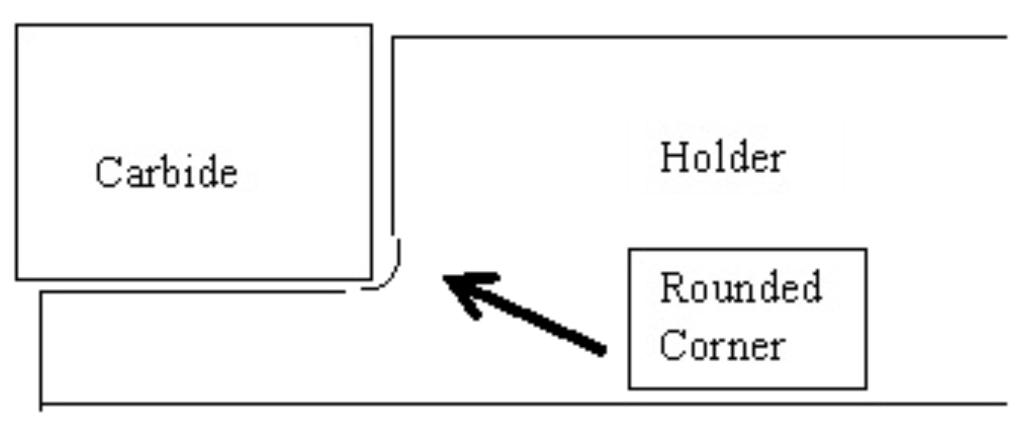
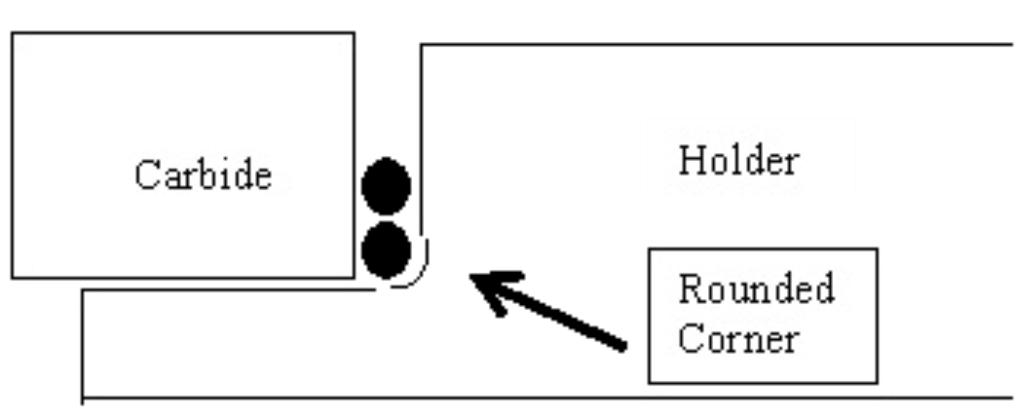
In this the beholder was machined in such a manner that it left a radius in the corner of the notch. This means that the carbide cannot be seated completely against both the bottom and the side. The best choice is to seek the carbide fully against the bottom.
The problem is that this leaves a gap which nobody likes.
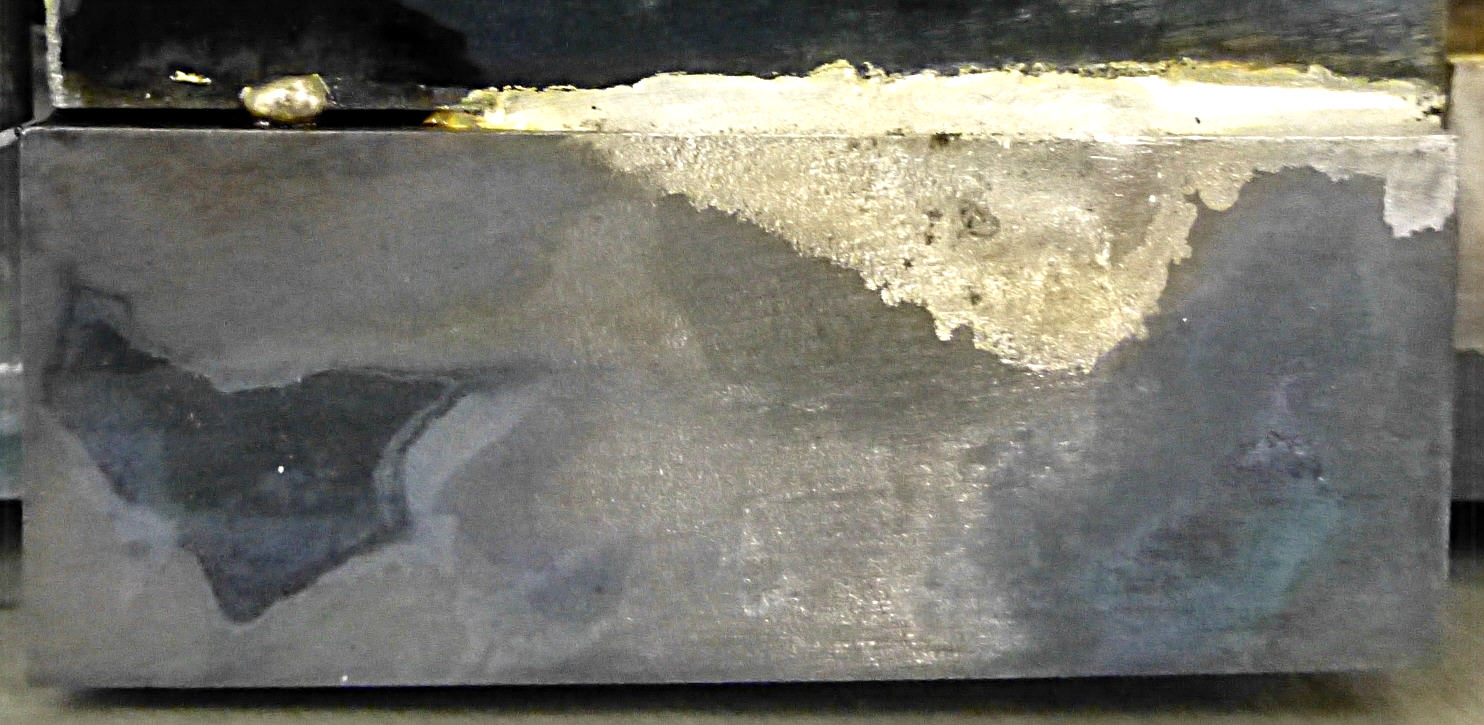
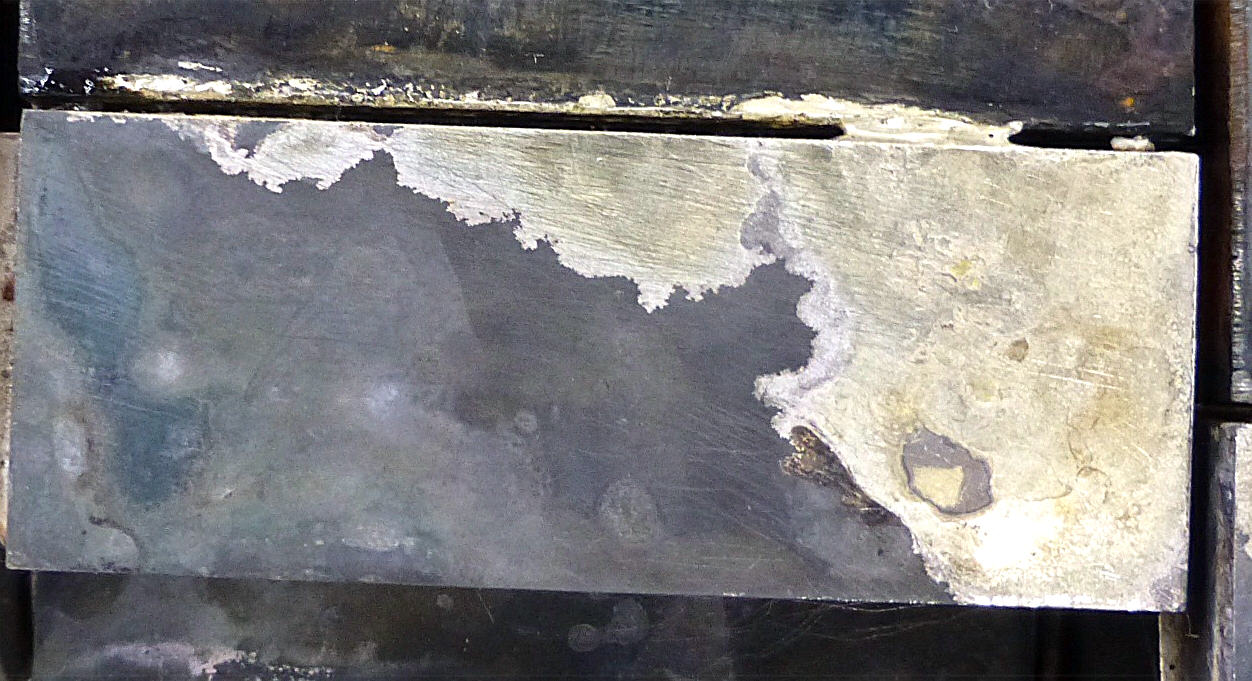
If you are in a situation where the gap is really wide you may be able to poke braze alloy down into it. I usually end up with a fairly narrow gap. I have yet to find a good way of filling that gap after the brazing is completed. If I try to reheat and flow the braze alloy into the gap it almost always wants to run across the top instead of down into the gap.
The following three pictures are pretty typical of what I see.
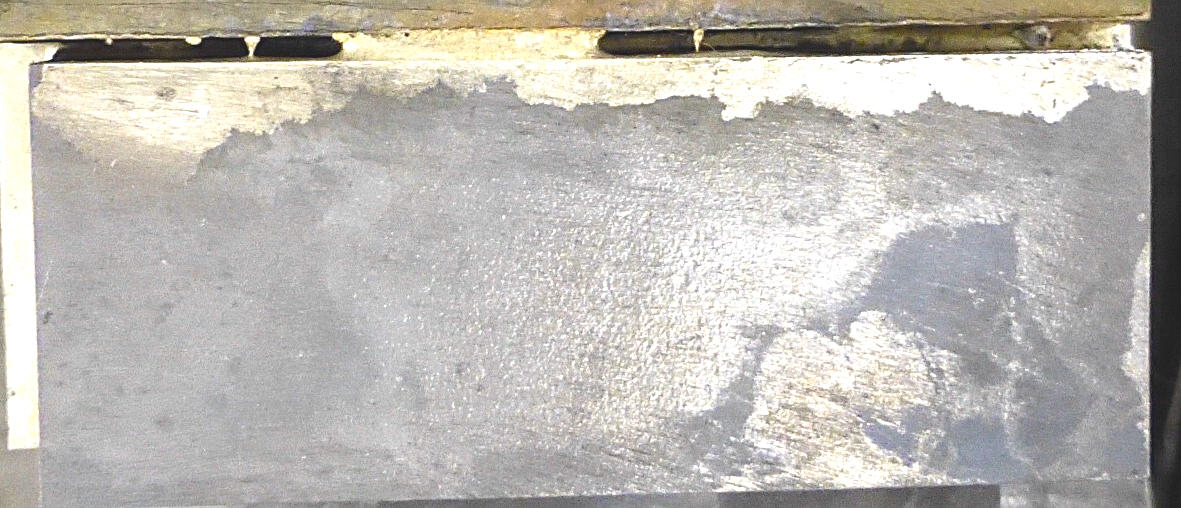
The best technique for avoiding this is to place the fluxed braze alloy wire in position as shown in the drawing below by the two black dots. Once these dots come up to temperature you can push the carbide in and fill the gap with braze alloy.
The other side of this is that the gap is rarely functional but it is always an issue cosmetically.
Differences in Braze Alloys
Posted on Friday, December 7th, 2012 at 9:38 am.
Effects Of Different Braze Alloys
In the late 1980s the government really cracked down on cadmium in braze alloy. The Bag-3 braze alloy had been the standard. The industry switched to a 50% silver braze alloy without cadmium and immediately saw a dramatic increase in both tip loss and carbide tip breakage in sawmill saws and other tools. Carbide Processors Inc. designed a series of experiments. With the cooperation of Cascade Southern Saw Company and SystiMatic Saw Company a series of sharpie impact tests were run at the Weyerhaeuser Tech Center in Federal Way,Washington under the direction of Don Anderson who was then Head Of Cutting Tool Research And Development. The incidence of tip loss and tip breakage, and / or the energy required to affect the same indicated that the Bag-24 braze alloy made braze joints that were about 30 to 40% more likely to fail than the Bag-3. Bag-22 braze alloy was also tested and found to be equivalent to the Bag-3. BAg-7 was found to be roughly about half as strong as Bag-3 or Bag-22. We use Bag-22 Braze alloy as a standard for most of our Pretin services.
In the mid-1990s, George Bellwoar of Engelhard did some work on braze alloy and tungsten carbide/braze alloy/steel joints considered as a single composite structure.
We did some testing on the effects of pretinning of tungsten carbide. We used a drop weight impact tester. We tried tests three ways. We took carbide parts with braze alloy on one side. We dropped the weight directly on the side with the braze alloy and it was much harder to break the carbide parts that I was to break identical carbide parts with no braze alloy. The same results occurred when we put the braze alloy side against the table and dropped the weight on the opposite side. Surprisingly enough, we also saw similar results when the braze alloy was not directly involved in the impact path. That is, we laid the tungsten carbide part with the braze alloy on one side so that the weight directly impacted the carbide and the carbide was resting against the steel with no cushioning braze alloy layer.
So there seems to be good evidence that braze alloy somehow affects the way that stress, strain, and force is handled in an assembly of tungsten carbide brazed to steel.
Why tungsten carbide fails
The first and most obvious consideration is the amount of energy trapped in the assembly by the differences in coefficients of thermal expansion between the tungsten carbide and the steel.
There is also, perhaps, a cushioning effect provided by the braze alloy. This cushion is thought to absorb impact energy. The impact energy of the tool in use is transmitted through the tungsten carbide and absorbed in the softer braze alloy.
There is research that shows that the mode of failure for tungsten carbide is not compression but rather tension. In use this would mean that the carbide does not break when it hits something, but that the breakage occurs after the force is released and the carbide springs back. It is a basic design principle when dealing with tungsten carbide that it is extremely strong in compression and very weak in tension. I would hypothesize that a major part of this is the fact that tungsten carbide, as it is commonly used, actually applies to a composite of tungsten carbide grains cemented together with cobalt. Cobalt is a pretty brittle metal.
Braze alloy and what it does…
Posted on Thursday, December 6th, 2012 at 2:37 pm.
What Does Braze Alloy Do?
The immediate topic is brazing tungsten carbide to steel specifically for use in tools such as saw blades, router bits, etc.
Bonding Properties
30 years ago I was taught that braze alloy was sort of like a hot melt glue in that the bonding strength was based on purely physical bonding. The next step was to treat braze alloy in terms of chemical bonding. This seems to be much more accurate in that a physically rough surface which is not chemically clean will bond very weakly if at all.
Handling Stress
After considering braze alloy as a bonding agent the next step was to consider braze alloy in terms of its ability to reduce stress in the braze joint.
When brazing tungsten carbide to steel it is necessary to heat braze alloy up to roughly 1350 Fahrenheit or a bit higher. Most braze alloys used in this application are rated for service up to around 1500 Fahrenheit.
The difference in coefficients of expansion between tungsten carbide and steel are approximately 3 :1. Other figures are given and, of course, it depends greatly on which steel and which tungsten carbide. However the ratio seems to always be 3 : 1, 5 : 1 or higher.
When the braze alloy has reached full flow and the heat is removed then the two parts are locked together. As the parts cool and shrink the steel shrinks much more than the carbide which causes stress on the carbide.
This stress can be thought of as analogous to a drawn bow or perhaps an animal trap. Both of them contain a great deal of energy waiting to be released.
In the case of the tungsten carbide tool tip this energy can be released through impact in use. So a piece of tungsten carbide it may be strong enough to survive an impact on its own can fail if it is already highly stressed or stress loaded. The failure mode is a crack in the carbide. Typically it is a crack running through the carbide to relieve the stress. You can even see this crack occur during grinding of a saw tip, for example. I believe the removal of mass during grinding significantly weakens the tip. I also believe that the vibration and other energy loading it that occurs during grinding can contribute. I would guess that the mass removal is the more significant of the two but have no data to back that up.
(I understand there are a great number of definitions and ways of thinking of stress. I believe the way I’m using it here is fairly common and should make my point. As there is no absolutely authoritative source for defining these terms I have absolutely no interest in getting involved in such a discussion. I have been there, done that and it wasn’t any fun.)
It seems that a thicker layer of braze alloy or tri-metal piece of braze alloy can greatly reduce or eliminate so-called “Heat Stress“ failure. So it appears that braze alloy has a second function in making tungsten carbide tips more survivable than impact situations.
The Leslie Rose affect
Posted on Tuesday, December 4th, 2012 at 1:44 pm.
This term describes the effect that occurs when someone assesses an employee’s performance. It especially occurs when someone assesses the employee’s performance who has no idea what the employee actually does.
Many years ago I had an office manager name Leslie Rose. She came in, got things straightened out, got to know the customers and after a while things were running beautifully. I really appreciated what she was doing.
It was a while after that that I found myself thinking that Leslie had a pretty sweet job. She got everything done without working very hard at all.
Then Leslie Rose took an afternoon off to go to the dentist. Remember, I was under the impression that she did not work very hard so I did not see any problem in letting her have the afternoon off.
I got most of Leslie’s work done that afternoon. She usually left at four with everything done. I left at 6:30 with a big stack of notes about things I needed to finish the next day.
The point of this is that Leslie Rose had a demanding job but she was extremely good so she made it look easy.
Cooling Steel
Posted on Thursday, November 29th, 2012 at 12:25 pm.
When cooling steel, the way and the speed at which you cool the steel can have a great affect and possibly even change properties of the steel.
This was prompted by a question as to whether you can use water to cool a Forstner bit while you are cutting.
The answer is: You can cool a Forstner bit with water while you are cutting, but doing so may cause other problems and you are just disguising the source of the real problem. The best thing is to not allow the steel to get too hot. Cutting with dull tools is a common reason that tools get too hot when cutting.
Steel tools are not supposed to get hot. Warm is okay, hot is bad.
Very simply, steel can have different grain structures. Depending on how you heat and cool steel you can change both the toughness and the hardness of the steel.
It is very easy to overheat the steel and accidently change the toughness and hardness. My grandson learned about this process playing with one of my hotdog forks in a campfire. I now have one hotdog for where the times are a lot easier to bend than they are on the others.
The same affect that occured from overheating the steel in my hotdog fork can be applied to steel tools. You can even do it to tools without realizing it. There have been studies showing that the edge of the cutting tool such as a saw blade or a router bit can reach temperatures over 1000°F. This is hot enough to cause steel to change.
Depending on how hot you get the steel and how fast you cool it you can make the edge either harder or softer. An edge that becomes much harder is much easier to chip, and an edge that becomes softer will dull much faster.
