


Welcome to the Carbide Processors Blog
Why you Should Only use Saw Blade the way they were intended
Posted on Wednesday, November 21st, 2012 at 8:52 am.
Saw Blades were designed to cut forward. Running them backwards can put you and others around you at risk.
The first problem with running a saw blade backwards is that saw blades are designed to cut forward and a great deal of the strength of the saw blade comes from the design. If you look at a carbide tipped saw blade you will see the carbide tips sit in a notch. The design of the saw blade is such that the cutting action forces the carbide tip deeper into the notch and against the steel. If the saw blade is run backwards the force of the cutting action is such that it wants to pry the carbide tip out of the notch.
I have been dealing with tungsten carbide saw tips since 1981. A big part of that has been pretinning saw tips where each saw tip is inspected by a person who then puts a bit of braze alloy on it and runs it through a brazing oven. In 30 years we have processed well over 100 million saw tips, each of which was individually inspected before it was pretinned and after it was pretinned. So, when I say, that tungsten carbide parts vary between batches and also within a batch I have experience to back it up.
One way tungsten carbide saw tips vary is in their ability to bond with the braze alloy. Tungsten carbide saw tips are mixed from a powder mixture of tungsten powder, carbon powder and cobalt powder. There are many other variations but this one is the most common. If you do not have enough carbon in the mix then you get tungsten carbide parts that are carbon deficient. This is called eta phase. If you have a wee, tiny, bit too much carbon powder all your tungsten carbide parts are good and the excess carbon deposits on the surface of the tungsten carbide parts. The problem with this is that this free carbon deposits as graphite which creates a surface that does not want to accept braze alloy.
Tungsten carbide parts are sintered in an atmosphere controlled oven. This is much like baking cookies or crackers and the parts nearest the heat source receive more heat than parts farther away from the heat source even in the best of ovens.
Theoretically tungsten carbide does not oxidize below 1,000 degrees Fahrenheit. (Other temperatures are given but this one seems to be the most common.) If you are familiar with chemical processes you will realize that they do not take place instantaneously at a given time or a given temperature. You have to stir your coffee for a while to get all the sugar to dissolve. When you put an ice cube tray into a freezer, no matter how cold the freezer is, you do not get ice cubes instantly and different parts of the tray freeze faster than others.
It costs a great deal of money to run a sintering oven so there is pressure to remove one batch and get the new batch in. Tungsten carbide parts are often removed at a temperature well above room temperature. Theoretically any temperature below 1000°F is safe as it will not form oxides. However there are a great number of possible oxides all of which form at different temperatures. So it is quite common to see some oxide formation on tungsten carbide.
Sintered and cooled tungsten carbide parts are typically sandblasted to clean them up. One theory is that sandblasting alone is enough to remove all the oxides, free carbon and other contaminants on the surface of the tungsten carbide. This is not always true.
60 years ago L.B. Toney was granted a patent for a method to treat tungsten carbide so that it brazed better. In 1981 I started my business with a Weyerhaeuser contract to figure out how to keep saw tips on the saw among other things.
The best manufacturers treat saw tips to make them braze better but not everyone does this. In addition there are variations in the process as with anything else and sometimes the process just doesn’t work right.
Some saw blade manufacturers do incoming inspection to make sure the parts they get are right. Some do not. Some manufacturers control the quality of their parts all the way through the process and do testing on their finished parts. Some do not.
The quality of the saw blade has almost nothing to do with the price you pay for it. Some of the best made saw blades in the world are the incredibly cheap little saw blades from Black & Decker. Our World’s Best custom saw blades and our All American saw blades really are better than any other saw blades in several measurable, quantifiable ways as well as in user reviews. This is in spite of the fact that they sell for less than other saw blades.
If you spend enough time in design and practice and buy the best equipment it is entirely possible that you will produce superior results with less effort than others. This is true whether we are talking about golf, fishing, or manufacturing.
Anyway, there are definitely good and bad saw blades. By bad saw blades I mean, in this case, saw blades where the saw tips are more likely to come off.
You cannot always rely brand name. The tool industry is full of examples where a high quality company was bought out by another company that immediately cheapened the product.
Even if the company doesn’t change ownership it may change management. There is a Wendy’s restaurant across from the bank branch I use. I finally figured out that the food is really good on days when the general manager is working there, pretty good most of the time, and pretty bad on Fridays when there is a substitute manager of some sort. The same thing is true in manufacturing. Some managers are just better than others. Some companies go through management changes at the top level. Quite often the new manager will do exactly the opposite of the old manager. The old manager was all about quality. The new manager comes in and decides to increase profits by cutting costs.
Running Saw Blades Backwards
Posted on Thursday, November 15th, 2012 at 1:58 pm.
This was in response to a customer’s question about running a saw blades backwards.
Comment:
I have been having an argument with several people regarding cutting aluminum on a table saw with the saw blade reversed so that the back of the teeth do the cutting. My argument was that it was possible, but not good practice. The others argued that it was a perfectly acceptable method. My argument was that the right saw blade should be used if it was done on a regular basis, but you could get away with the blade reversed, if done infrequently such as a DIY project where the cost of a different blade wasn’t warranted.
Dear Sir:
Executive Summary:
1. This is a case where the tool is being used in the direction it is weakest.
2. This practice may work with some saw blades but some saw blades are much weaker than others.
3. Saw blades, even from the same manufacturer, can vary greatly in quality.
4. Cutting situations that appear to be identical can vary greatly.
5. A circular saw is quite possibly the most dangerous tool the most people ever use. It is a very thin piece of somewhat brittle metal traveling at up to 200 mph.
6. Cutting accidents occur all the time and always by surprise. Anyone who has ever used a circular saw has had experiences with saw blades jamming or binding.
7. You never really know what you are cutting. The most obvious example is knots in wood or staples and nails in other materials. Metal is often regarded as an entirely homogenous material. If you have enough experience with metal than you realize how hard it is to get a sheet, bar, billet or similar to be 100% consistent.
To put it plainly, it is just best to use a tool as it is intended to be used and to find the right saw blade for your application. This keeps you safe and ensures the longest life out of your tools.
You may not get hurt but you are greatly increasing the odds that you will.
In 1993 I was 47 years old and decided to take afternoons off and go home and paint my own house. I did it when I was in my teens and 20’s and figured I could still do it. I could save some money and spend afternoons out in the sunshine doing physical work instead of in the office shuffling paper. Everything worked really well until the ladder slipped and I broke both legs. I spent about six months in a wheelchair and four years more on crutches or a walker as I had repeated surgeries to try and save my legs. The good news is that I still have both legs although neither one works very well.
Since then I have become much more careful about assuming that I was invulnerable and about taking chances to save a couple dollars.
Legal
As a manufacturer, with a great deal of concern for the safety and health of my customers, I cannot advocate using any tool improperly.
In this case I have a horrible vision of the carbide tips getting shelled off the saw blade like corn off a cob.
Okay. The legal is out of the way. Let’s get down to the practical and real life.
Saw Tips Do Come Off And Saw Blades Do Come Apart.
Over the decades I have had way too many calls, letters and emails from people who have lost the vision in one eye because a carbide tip came off the saw blade and blinded them.
There are a great number of sawmills where the roof over the saws is full of holes because the saws hit something that was thrown up at the roof, the saw tips came off or the saw hit something much too hard, such as a railroad spike buried in a log, and the saw blade shattered and came apart as shrapnel.
Explanation Of The Dangers
It is very difficult to make saw blades that are consistently safe to use when used as designed.
I am aware that people deliberately use saw blades to cut aluminum extrusion, roofing panels and other materials by putting the saw blade on backwards. I am also aware that there are a fair number of people out there who do this successfully and have done so for a long while.
Every time a dangerous practice is discussed on the Internet invariably there are a couple of people who post and say something to the effect that they have been doing it for decades and they are just fine. Assume that this is entirely true.
No Two Things Are Identical
The first problem with this is that no people are absolutely identical. If you have ever known identical twins then you know that there are differences, no matter how slight. So someone who misuses chemicals without harm may have a particular body chemistry that allows them to do that. This does not mean that anyone else can do it.
At a certain level no two manufactured parts are identical. If you have ever done anything that involves a large number of parts you have undoubtedly had the experience where you found a defective part or a bad batch.
If you have ever dealt with parts that are made in a batch then you have had the experience of having some parts in the batch being different than others. I bought a box of saltine crackers last week. Three tubes of crackers were just fine. The fourth tube of crackers was a little overcooked on one edge which affected the color and the taste to a minor extent.
There is a huge amount more I could provide but that should give you a pretty good idea of my position on the matter.
Tom Walz
Bandsaw (Band Saw) Blade Brazing
Posted on Tuesday, November 6th, 2012 at 3:23 pm.
There are 6 basic steps to brazing a band saw blade.
- Clean and bevel the blade ends.
- Clamp blade ends to the fixture.
- Spread the flux.
- Braze.
- Anneal
- Remove excess alloy.
1. Size of blade
With a very small, narrow band saw blade it may be possible to join the two ends by soldering. Soldering occurs below 800 F. (Other temperatures are sometimes given but they are all in this range.) Soldering is low temperature and typically makes a soft, weak joint.
With larger band saw blade and with blades where a strong joint is needed you will need to braze.
2. Selecting a solder or braze alloy.
For brazing you will need a silver solder or silver braze alloy as opposed to a typical solder. Typically solders have something like 3 to 5% Silver in them. Braze alloys have a silver content somewhere around 50%.
There are typically four braze alloys that work well. They are sold under various names. I have included the BAg numbers as these are the official AWS (American Welding Society) designations. You can typically identify the braze alloy from a supplier based on the number sued. E.g. Easy Flo 3 is a Bag-3 alloy. 50Ni2 is a 50% silver with 2% Nickel.
These alloys melt over a range. The solidus is the highest temperature where they could be considered a solid. The liquidus is where they are officially a liquid. It is typically good practice to melt the braze alloy to a point about 50 F over the liquidus.
1. BAg-3; 50% Silver with Cadmium 1170 solidus to 1270 liquidus. Strongest braze joints. The historic favorite. Easy to use and strong joints. Not used as much in the past decade due to the health risks with Cadmium.
2. BAg-22; 49% Silver with Manganese. 1260 solidus to 1290 liquidus. Strongest braze joints. As strong as Bag-3 and Cadmium free. A bit harder to use. Brazes pretty much like the other alloys but it does have a tendency to form little nodules or lumps
3. BAg-24; 50% Silver and Cadmium free. 1220 solidus to 1305 liquidus. About 30 to 40% weaker than the above alloys. Takes a little more heat. When it does get to temperature it wants to run faster and farther.
4. Bag-8; 56% with Tin. 1145 solidus to 1205 liquidus. Very easy to use but a comparatively weak alloy.
Forms of Braze alloy
These alloys come as a paste, a ribbon or wire.
1. Paste is easiest to use and most expensive. It is flux and alloy mixed together with a binder to prevent the heavier alloy particles from separating to the bottom. You squeeze a little paste between the two parts and heat them.
2. Ribbon is a thin strip. If you use ribbon it should be no more than 0.005” thick and 0.003” is preferable. You dip the ribbon in flux; put it between the two parts and heat.
3. Rod or wire. Comes in various diameters and is generally least expensive. You flux both halves by dipping or painting. You can put a bit of wire between the two halves and apply heat. You can also apply heat until it is read then touch the assembly with wire or rod. If it is hot enough the alloy will flow into the joint.
You will need brazing flux with ribbon or wire and extra fluxing with paste is a good idea. Black flux is more forgiving than white flux. Flux has some cleaning and oxide removal properties but best not to count on it. Start with clean parts instead. Flux is primarily an oxygen interceptor so that the parts and braze alloy do not oxidize.
3. Grind the blade
Each broken end of the blade should be ground to an angle of about 45 degrees to provide a scarf joint. This process also cleans the damaged ends. Quickly running it across the bench grinder is enough to do this. A Dremel tool fitted with a small drum sander works well and is easier to control.
Grinding the ends with the teeth opposite to each other and grind both at once. Allow about a half inch for the lap joint.
You want to end up with the two ends looking something like this. A lap joint will be much stronger than a butt joint and you can do all your brazing from one side.

Once ground, keep the steel free of any oil and dirt.
4. Fixturing
The blade ends should be clamped onto a steel jig using toolmakers clamps, or something that will not overheat and burn or melt. Make sure this joint is aligned the way you want it.
These pictures will give you an idea. You can just use a flat piece of steel and see how that works for you. You want to hold the two halves in place without crushing any teeth. The steel will want to move a little as it gets hot. Be ready for it.
5. Heating
If using wire, coat each end of the blade with paste flux and heat the whole of the joint to bright cherry red before applying the solder. With the blade still bright cherry red gently pinch the joint together with a pair of pliers. This provides for a flat, even joint. Gently, gently, gently. Do not squeeze all the braze alloy out. If you have 0.001” to 0.002” braze alloy between the two parts it should be right. Less is o.k. as long as there is still some braze alloy.
Brazing the blade should be quick and easy. The blade is thin so it won’t need a lot of heat to get it to temperature. If you use a paste flux the water will boil out. Then nothing. Then the flux will bubble up and look pretty bad. Then the flux clears up and braze alloy melts.
Remember the difference between heat and temperature. Flux gets used up by a combination of heat and time. Too much heat, taking too long to get silver braze to melt will cause flux to get used up dissolving oxides and go black and no longer work and also more time for blade to expand and the overlap joint to slip over it self getting a thicker joint with possible thin spots on both sides after grinding back.
5 – A. Alternate heating method
You can also heat a pair of brazing tongs bright red and clamp the two parts together. The red-hot tongs wiIl heat the blade and melt the solder. Keep the tongs clamped on the joint until they turn black.
6. Inspection
Check to see that you have a nice even line of braze alloy all the way around the joint. If you have to you can reflux, reheat and apply more braze alloy. It should be the color of the original alloy without too many holes in it. Holes mean you boiled the zinc out of it.
7. Annealing
After you have heated the joint enough to get the braze alloy to flow, back off the heat and let it cool a bit. A short annealing carbon steel is necessary for high speed steel. The high speed steel blade joint is re-heated to slightly below the melting point of the solder and the torch’s flame backed away allowing the joint to slowly cool. The process is repeated two or three more times taking the temperature to a lower point each time and allowing the blade to cool slowly. File a piece of un-annealed steel and the file will slide. On the annealed steel it should bite.
9. Cleaning Flux
After the blade has cooled to room temperature, remove the excess flux by brushing under warm water. If you used enough flux it will be very dark and easy to remove once it has cooled. If the flux is clear and hard to remove you burnt it all up. Use more next time.
10. Grind or File Flat and Smooth
File or grind the blob of solder off flush with the surface of the blade and flat off the blade edges to allow smooth running of the blade through the saw guides.
Notes:
1. Do not use wood for a fixture for brazing. Brazing typically takes place above 800 F. Wood burns around 1200 – 1400 F. The most common braze alloys for this work (49, 50 or 56% Silver) melt around 1300F. An oxy -acetylene torch runs at 4,000 F +. Can’t see where using wood for a fixture is a good idea.
2. Do not cut the blade near the original weld unless you cut the weld out entirely. Stay far enough away so that the weld from the factory does not get too hot to touch. Remember that the clamps will serve as a thermal barrier to some extent.
What Do You Get In A Quality Tool?
Posted on Tuesday, October 30th, 2012 at 3:41 pm.
The question “What do you get in a quality tool” came up on a forum today. Somebody needed a new endmill and was looking at two different endmills. One end mill was higher quality, but cost four times the amount of another one. He wanted to know what he got for the extra money.
Two thoughts come to mind. First is the hamburger analogy. When I go
to the bank I drive right through hamburger row. There are maybe a
dozen or more franchise restaurants, many of them selling hamburgers
in one form or another. When I just need to refuel I will buy one
from a chain. When I want a really good hamburger I drive over the
hill to Marcie’s where the patties are hand formed and cooked to
order. There are a lot of things that make Marcie’s Burger much
better than a chain burger.
If you are good at anything, then you understand how the process effects the quality of the end result. If you are a good cook then you understand the importance of selecting really good ingredients. You understand the importance of good equipment and you really understand the importance of years of experience.
If you are a good woodworker then you carefully select the wood for
your project instead of taking whatever’s on top of the pile. Your
table saw and fence are aligned to cut straight and true. Your saw
blade is sharp. You know how to feed the wood so you get a clean cut
without burning. You use quality tools and equipment becuase that will ensure you get the best results.
If you are a machinist you understand the difference in metals. You
understand that different metals require different cutting techniques.
Different kinds of cuts may require different machines. You
understand the importance of good bearings and tight spindles. You
understand the importance of a flat tabletop and accurate instruments.
If you are a cook, machinist, woodworker, golfer, fishermen, hunter or
anything else then you can develop a long list of what needs to be
done to get geat results.
This same process applies to tools. Tool manufacturers that make quality tools choose the materials for their tools carfully. They apply great ingenuity and experience when executing their tools and creating new tool designs. They use the best equipment. They use a process that yields the best results, which are really great, high quality tools.
A top-quality tool will give you better cuts, longer. Manufacturers that produce top quality tools are consistant in their manufacturing so that every tool you buy from them will be just like the last tool you bought. If you have ever replaced a
tool in the middle of a job with one that had exactly the same
specifications but cut differently than you understand why this can be
extremely important.
We understand the importance of the tools you use, which is why we only sell what we belive to be exceptionally high quality tools. We now have well over 18,000 tools including router bits from Whiteside, Vortex, Southeast Tool; Router Tables from Incra and Woodpecker; Saw blades from Tenryu, Popular, and our Custom Saw Blades and hand tools from Mayhew, Wiha, Wera, and Bondhus.
Interesting fact about particle board
Posted on Wednesday, October 24th, 2012 at 11:17 am.
An interesting fact to keep in mind when cutting man made materials is the difference in the material depending on it’s origin.
A great deal of man-made material is made of wood fiber, sawdust, etc. glued together. That binder or glue very often includes clay as a filler.
In the United States Clay is anything that is less than 0.00015″ (15 /
100,000) inches in diameter. In Europe the standard defines Clay as
anything that is less than 0.000079″ (79 / 1,000,000) inches in
diameter.
The volume of a sphere is 4/3 x pi x r3
The volume of the largest clay particle by European standards is
0.000000000000258 cu. in. The volume of the largest clay particle by
US standards is 0.000000000001767 cu. in.
The US particle has about 6.8 times the volume of the European particle.
There is also the fact that the clay used as a binder is a highly
variable material both as to particle size and particle constituents.
If you make the assumption that you are routing more sawing wood and
glue then you can have very short tool life. If you add in the fact
that you are cutting your way through very fine sand (which is what
clay is) and design your tools accordingly you can get much better
cuts and much longer tool life.
Our World’s Best Saw blades are designed with a special Cermet Carbide Tip that stays sharp longer, even when cutting abrasive material. World’s Best Saw Blades have up to 5 times longer tool life than standard carbide saw blades when cutting these materials.
How Temperature Impacts Tool Wear
Posted on Wednesday, October 17th, 2012 at 2:53 pm.
Harold Stewart has recently published an article that demonstrates the great affect temperature can have on tool wear. The information from this article was taken from the experiments and articles published by Harold A. Stewart from Mississippi Forest Products Lab.
Abrasion has been assumed to be the main culprit when evaluating tool wear for cutting MDF. Many believed that the materials making up MDF such as the adhesives and silica were the major causes for abrasion and tool wear. However, MDF as well as dry wood products and reconstituted wood products such as Mali involve a high temperature and pressure in the cutting zone and at or near the tool edge. It was found that high-temperature corrosion was found to be a major contributor to the wear of tungsten carbide when cutting MDF. The high temperatures that result at the cutting zone may actually contribute greatly to the wear of the cutting tools.
A little background on high-temperature corrosion:
High-temperature corrosion is most commonly associated with extraordinary reactions to form a salt deposit on a metal or oxide surface during combustion of fossil fuels.
In our case, high-temperature corrosion refers to a wedge-shaped tool sliding through a series of oxidizing and reducing agents accompanied by exceptionally high temperatures and pressures.
These temperatures have been measured and have been estimated to reach up to or be near 800 degrees Celsius at the tool edge when cutting wood. The rate of hot corrosion depends on many different things including the material being cut, the position, the microstructure, salt composition, atmosphere, temperature, extent of thermal cycling, salt or scale thickness, geometry of the material, and erosive conditions.
Due to the properties of MDF, The combination of cutting MDF wood with Tungsten carbide becomes a perfect recipe for high-temperature oxidation/corrosion.
Hot Corrosion:
Hot corrosion occurs when cutting MDF and results from the major wear mechanisms and factors which occur.
The four major causes of wear are adhesion, abrasion, diffusion (tribochemical reactions), and fatigue. Each of the causes may affect tool wear to a different degree, depending on the specific machining situation and may interact or be part of other causes.
1. Adhesion is the formation of “welds” between the work piece and tool. The wear from adhesion results from the breaking of the “welds” or joints between the work-piece and tool.
2. Abrasive wear includes rubbing, plowing and cutting depending on the properties and geometry of the individual grits and work piece surface.
3. Diffusion is the atomic transfer of one material to the other at points of contact and. is considered an integral part of the other causes of wear.
4. Fatigue results from cycling of stresses or change of stress as the tool and work piece interface as they pass by each other. Fatigue is probably the least apparent in woodworking.
The four causes of wear listed above depend on time, temperature and pressure. They also require that the tool and work piece surfaces are forced into close proximity with each other.
When machining wood and wood-based materials, three factors affect the causes of tool wear:
1. The tool rubs against the freshly cut, highly oxidizable surface of the chip or work piece. Plastic deformation of the work piece material results when forming the chip.
2. The temperature and pressures at the sliding interface(s) are exceptionally high.
3. The tool is brought into close contact with a highly chemically reactive surface of many ions and mechanically severed bonds at high temperatures and pressures.
When looking at these three factors, it seems that the MDF cutting environment may be substantially more severe than a metal cutting one.
Wood is technically a three dimensional polymeric composite which is a relatively good thermal insulator. Because dry wood or wood-base products, such as MDF, have low thermal conductivity, the cutting temperatures generated are higher than was believed in the past. Unlike many metal-cutting situations, the work piece, chip, tool and/or coolant cannot conduct heat away from the cutting zone. Most of the heat generated goes into the tool. Therefore, the high temperatures and pressures and chemical components of a wooden work piece are a bad environment for cutting tools.
Conclusion:
This complex combination of reactions indicates the importance of limiting or carefully selecting adhesives, catalysts, additives, etc. for wood composites such as MDF.
These results also indicate the importance of selecting refractory tool materials for wood machining.
By considering tool wear causes with contributing factors such as high-temperature corrosion/oxidation, wood products and tool materials can be improved and selected to decrease tool wear.
These studies and results have led to the application of new ceramic cutting tools, diamond coated tool materials and new carbides.
Burning Coolant mixed with Saw Dust
Posted on Monday, October 15th, 2012 at 4:04 pm.
Is it okay to mix Grinding Coolant with Saw dust to burn? This was an issue that was brought to Tom by one of our customers. Wanting to be absolutely certain that we gave this customer the right answer, we checked with the experts.
The information below comes from Kerry- a hazordous waste and toxic reduction engineer:
Here is some information about combining machine coolant as a fuel with sawdust. It seems to apply mostly to oil-based coolants.
Kerry Graber has several different scenarios based on the chemical make-up of the coolant.
An oil-based coolant used for grinding or cutting can be managed as used oil if it does not contain any chlorinated hydrocarbons. It is okay under our rules to send it to a used oil processor for blending into fuel in the same manner as other used oil.
If it is oil based, does not contain chlorinated hydrocarbons, but they want to blend it in with sawdust for burning, it is actually okay to do that because it is being used as a fuel just like any other used oil in this state. However, if they are burning it in an on-site burner, it has to be either an industrial boiler or furnace, or a space heater that is designed to have a max capacity of not more than 0.5 million Btu per hour and the combustion gases from the heater are vented to the ambient air. Used oil burner regulations might apply.
If the above is true but they are sending it offsite to be burned, there’s all kinds of used oil requirements for off-site burners, and the generating facility would also be a used oil marketer.
If it contains any chlorinated hydrocarbons, it would have to go through designation to see if it is a dw (Designated Waste). It may not be managed as used oil because -515 has a prohibition against it. If it is not a designated waste after designation, it would be a solid waste and I believe mixing it into sawdust for burning on-site is probably okay. I would defer to the solid waste program and the local health department on that call. Of course if it turns out to be a dw, they can’t manage it with sawdust it must go to a TSDF or legitimate dw recycler.
Allen Wrenches
Posted on Wednesday, October 10th, 2012 at 2:28 pm.
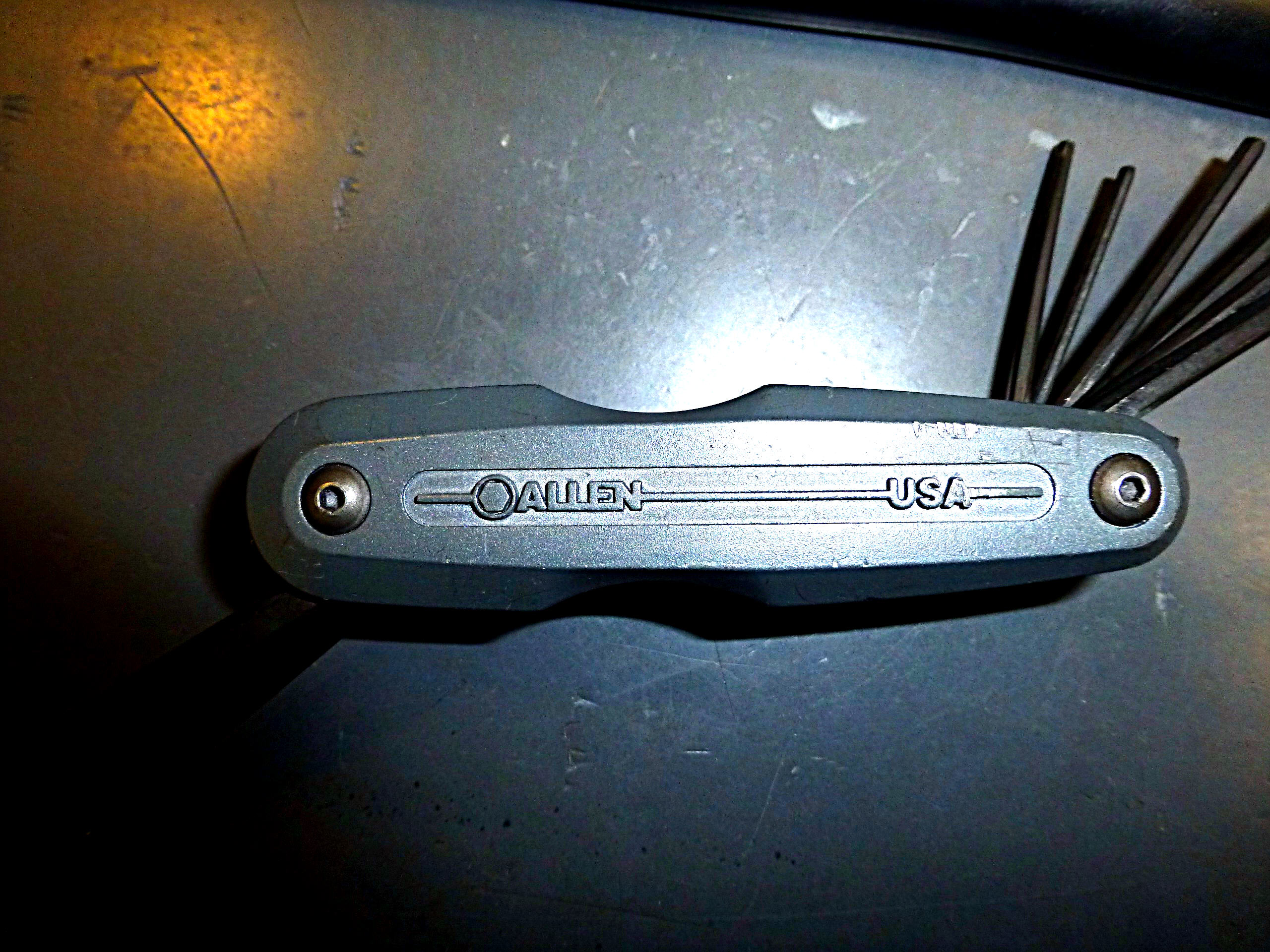
I found this old set of Allen wrenches. I’d forgotten I even owned it. I was rooting through some old tools looking for stuff to give my grandson Max for his fifth birthday.
These are genuine Allen wrenches made by the Allen company. The Allen company has trademarked the name so we can’t sell Allen wrenches instead we sell hex keys, and hex wrenches, L wrenches with hex heads, T wrenches with hex heads and so on from Bondhus or Wiha.
When we decide what tools to sell we think about the guy whose boat is broken down out on the water. We think about the farmer out in the middle of the field or the maintenance man who is working underneath a machine with a production line shut down. We think about people who own really fine guns or fishing reels or motorcycles or cars. We want to sell tools that are going to work when people really need them to work.
These Allen wrenches don’t meet that test. You can see in the picture below the end of one of the wrenches where it is rounded off and deformed. There is another picture showing two bent wrenches. One is really bent. The other one is just slightly bent so I put a red line underneath it to point it out.
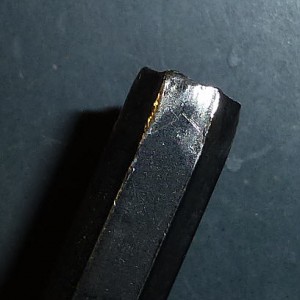

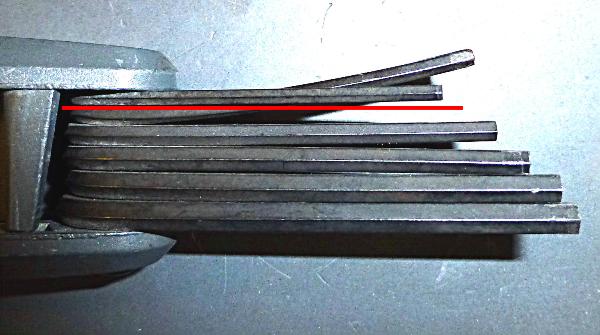
A rounded off tip is going to make it really hard to turn the screw as is a bent tool.
One of the things we also think about is somebody who’s working on a really fine piece of machinery or furniture. What a tragedy it is when a cheap tool slips and puts a gouge in an otherwise beautiful piece.
Cheap tools are cheaper, but We’ve learned that in the end you usually end up paying more for a cheap tool then you would have if you bought a quality tool in the first place. Anyone who has been injured by using cheap tools, or ruined a fine piece of work or material from cheap tools knows this first hand. We only sell tools that we would want to use ourselves, and we only like using really great tools.
Great tools on sale now- Shop for Wiha and Bondhus hand tools.
Differences Between Welding and Brazing
Posted on Monday, October 8th, 2012 at 2:13 pm.
Brazing Isn’t Welding; Brazing Requires Much Better Cleaning
Brazing is regulated by the American welding society AWS which is about as good a place as any to put it. However there are differences.
Brazing requires a much higher standard of cleanliness than welding does in order to be successful.
For over 30 years I have been solving brazing problems by getting people to change their cleaning methods.
Many people get successful welds without any cleaning at all. Good welders will remove all oils, greases, dirts and other contaminants. They may do this with something like an alcohol or an acetone wipe.
Cleaning preparations that work for welding may not be good enough for brazing. In brazing, any layer of oil, grease etc. left can seriously interfere with the brazing process.
In a very simple example of welding you will take two pieces of the same kind of steel and melt them together. This happens at about 2500° F. In addition the act of welding and heating the parts causes airflow. If you have traces of oil left on the steel it gets burned off and the fumes disappear. If minute amounts of the burned oil get mixed in with the steel it doesn’t cause any problems.
Brazing carbide usually occurs around 1350 F or about half of welding temperature. In addition the brazing process occurs between two parts so any oil left on any parts stays right where it is. If you are brazing carbide to steel and the steel is not entirely clean you will have a layer of burnt oil between the braze alloy and the steel.
Wiping with a solvent may or may not be enough. A much better technique is to use a strong caustic or detergent. The solvent just dilutes the oils and greases. The caustic or detergent actually breaks down the oils and greases so they can be rinsed away.
For best results in Brazing try MEGA Flux. It has gone through extra processing to eliminate any particles that may get between the steel and carbide during the brazing process to weeken the braze joint and has 78% better cleaning properties over standard and purified flux.
Interesting Video on Lumber
Posted on Monday, October 8th, 2012 at 8:57 am.
Here is an iteresting video on pre- cut lumber process. Hope you enjoy it!
Dick Brenier Shared this video with us. Columbia Vista also make lumber for this market.
