


Welcome to the Carbide Processors Blog
Best Saw Blades
Posted on Wednesday, July 25th, 2012 at 10:20 am.
We are very picky about the saw blades we sell and only sell from saw blade manufacturers that make absolutely top-quality saw blades. We do all the research so that we can bring you the best saw blades crafted with the finest steel plate, carbide tips, and braze alloy.
Anybody can get a piece of steel, braze some odd carbide on it and call it a saw blade. Making a really good saw blades is incredibly complex. There are about eight special kinds of steel for saw blades. They come from eitherEuropeorJapan. If you want to buy some the minimum order is 100 tons at a time or 200,000 pounds. You have to buy it in flat sheets, which adds to the cost because buying it in rolls is cheaper. If it has been rolled then it will always have a tendency to roll back up and you want saw blades that are going to stay flat.
There are roughly 15,000 grades of tungsten carbide and you want a grade of carbide that’s going to be right for the saw’s application. There are about a dozen different things you can add to the tungsten carbide to improve the performance of the saw blade. The different types of material added to the carbide will improve it for specific applications.
The steel saw plate cannot be punched out but has to be laser cut. Punching the saw plate will distort the edges. Once a saw plate has been laser cut you need to go back and remove the heat affected zone on the edges of the saw blade so it will braze properly.
The saw plate has to be heat treated then hammered for perfect flatness. It has to be tension rolled so that it will have enough stiffness but still be resilient enough.
There are about six different kinds of braze alloy. The kind of braze alloy used determines how well the tips will stay on and how well the tips will survive under impact.
The wheels used to grind the carbide are specifically designed for that application. Top-quality manufacturers are so fussy that even the size and shape of the crystal structure of the diamond is important.
We sell saw blades from 4 different Saw blade manufacturers that meticulously craft top quality saw blades by taking into account the importance of each material used and the method used to build the best saw blades. We feel that these manufacturers cater to the needs of all woodworkers.
World’s Best saw blades are a great investment for the saw shops and woodworkers who give their blades a lot of use and abuse. Our custom built saw blades will save you hundreds in sharpening and retipping fees. These are an exceptional blade that use a special patented Cermet II material for tipping. The special tips allow the World’s Best saw blades to last longer, resist breakage, stay cooler, and cut faster and cleaner. Take a look at the user reviews – many boast that it’s the best saw blade that they have ever used.
Tenryu Saw Blades are known for their quality. Our engineering department considers Tenryu Saw Blades to be the finest production, mass market saw blades made. We have tested these in small and large cabinet shops and they are far and away preferred over any other mass market saw blade.
Popular Tools is a newly added line of saw blades to our website. They make great quality saw blades with a large selection for many applications. Popular Tools have been in the industry for over 10 years and for those 10 years they have focused on the industrial side of the market. Their target market has been professional level saw shops. Popular Tools has developed a reputation for extremely high quality at extremely reasonable prices. Popular Tools consistantly produce extremely high quality saw blades every time, with every saw blade and for every application.
For more information on our World’s Best Cermet II tipped custom saw blades Contact Us
Inspecting saw blades- Side Clearance
Posted on Tuesday, July 24th, 2012 at 1:30 pm.
When looking for a saw blade, it can be difficult to know how to choose a saw blade and what to look for to know if you are really getting a good quality saw blade. There are many aspects to a saw blade that will affect the longevity of the blade and the quality of the cut. One aspect of the saw blade that often gets overlooked, but does affect the quality of the blade and cut to a pretty high degree is the side clearance.
Side clearance is a measure of how far the side of the saw tips stick out from the side of the saw blade. Ideally side clearance would be the same for every saw tip although this is not the way it usually works.
Side clearance can make a huge difference in how well the saw blade cuts. If you have some teeth sticking out more than others the teeth that stick out will leave the arcs in the cut wood that everybody recognizes and nobody likes.
We do not sell any saw blades where the side clearance variances more than one half of 1000th of an inch (0.0005”). The great majority of the saw blades we sell are better than that. The great majority of the saw blades we sell do not have any measurable variance in the side clearance.
To measure side clearance you can use a side dial indicator. This is a side dial indicator and there is a little foot under the tile resting on the saw tip. Because saw tips can be tapered several different ways you need to move the side dial indicator around until you find the highest point and you use this as a measurement.
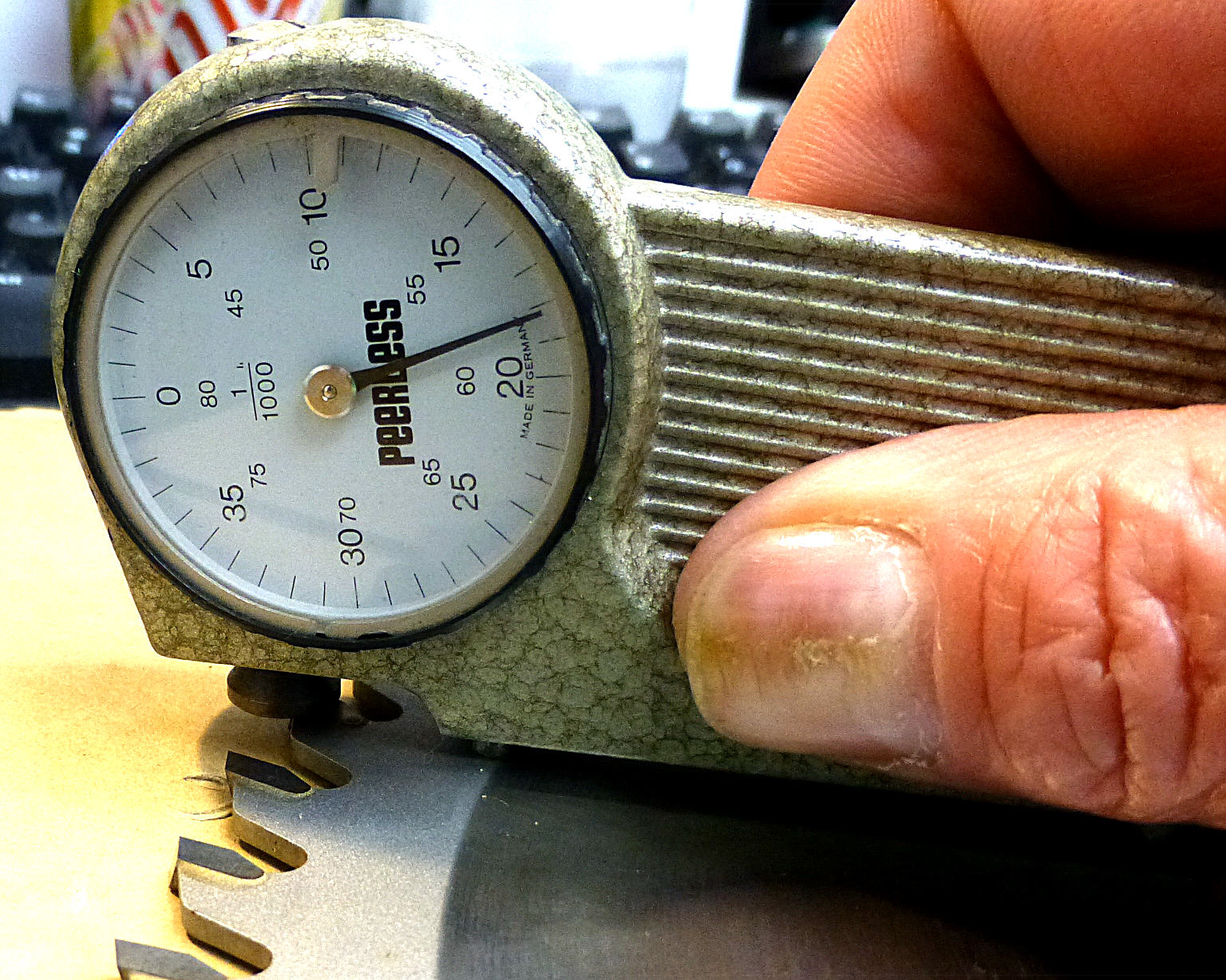
I record my readings all the way around saw blade then turn the saw blade over and record those readings. I like to start with the same tip each time. Some times a variation can be a problem with the grinding and sometimes a variation can be a problem with the tip moving. If the tip is short on one side and sticks out farther than it should on the other side it may tell you something about the wheel pressure in the grinding.
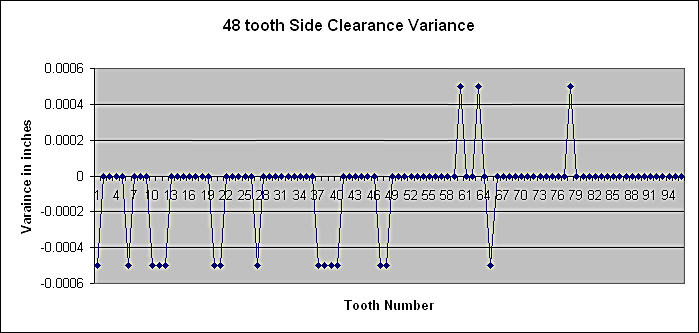
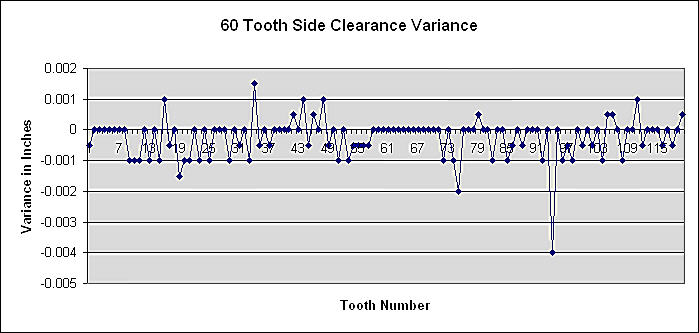
Here is the beginning of an analysis of two different saw blades. When I was done with these analyses I had 96 data points for the 48 tooth saw blade and 120 data points for the 60 tooth saw blade.

I enter this data in Excel so very easy next step is to make charts or graphs of the data.
Keep in mind that the importance is the variation of the side clearance, not the actual side clearance of each tip.
Once I have made the charts I can “File” and then “Save as” and then select ”Web Page”. This pulls the charts out of Excel and saves them as pictures in a special folder.
In the following charts you can see that the 48 tooth blade does have some side clearance variance but it is all in the range of one half of 1,000th of an inch (0.0005”).
The 60 tooth blade also has some side clearance variance but in this case it goes up to as much as 4/1000 of an inch (0.004”).
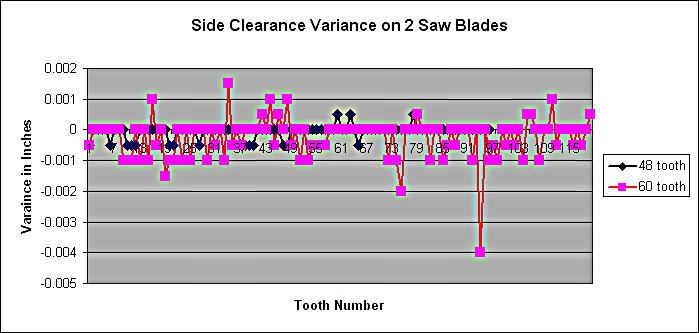
I made a single chart with the data from the two saw blades overlapping so as to better compare the difference.
Custom Machines- Standard Parts
Posted on Monday, July 23rd, 2012 at 3:07 pm.
When we get a chance to design and build custom machines, like our custom machine coolant filter units, we like to use standard parts. We believe in designing and building custom machines like ones that we would want to own. We use Standard parts for our Custom machines because Standard parts are easy to access and find if they ever need to be replaced. I have been in the industry long enough to know that there is far more money is using all custom parts. We have also been on the other end, where we are the customer with a custom machine that was built with custom parts, and know what it is like when one of those small parts needs to be replaced. Finding a custom part that is needed to fix the machine is not easy, and comes with a pretty hefty price tag. We believe in running our business in a way that will make things easier for the customer. We have been a customer ourselves, and know how it feels to spend time running down a small custom part, and having to pay a pretty high price to get it. Using custom parts does ensure the customer will have to come back to you if the custom machine ever needs parts replaced, but we would rather have our customers come back because they like our work and service.
Machines are supposed to run long and hard with minimum maintenance. If something fails it should be easy to replace with a standard, easy to access part. This is the most ideal situation for the consumer. Building custom machines with planned obsolescence and fancy parts just for the sole purpose of being able to inflate the price is not the way we want to run our business. We build custom machine filter units that may not look incredibly fancy, but they work well, last long, and are built with parts that are easy to find and easy to replace if ever needed. We believe in the golden rule- “Build the kind of machine you would like to own”, and that is exactly what we do.
Types of brazing flux
Posted on Friday, July 20th, 2012 at 1:56 pm.
Changing the type of brazing flux you use can yield different results in the brazed parts. There are 3 types of flux we will talk about: White flux, black flux, and purified flux. Black flux tends to be more forgiving and can yield much better results than White flux. Some people still prefer white flux because it allows them to see the work more easily.
In some ways you can compare using white flux over using black flux for brazing to using a .410 single shotgun to using a 12 gauge automatic shotgun for bird hunting. It requires a much higher skill level.
There are different types of black flux. We sell 3 different types of black flux: standard black flux, purified black flux, and mega flux.
Standard black flux does not meet the new purity standards. It is made with about 20% to 30% inert materials. It is great for exterior use, but if you use standard black flux between parts being joined the 20-30% of inert materials will deposit and weaken the joint. It is still possible to create excellent joints with this material. And millions of braze joints are made with standard black flux every day.
Purified black flux meets all standards for purity. Purified black flux is 99% active ingredients and makes for a much stronger braze joint.
Mega Black flux also meets all standards for purity. Mega Black flux is purified flux redesigned. It is sort of like the difference between conventional television and high definition television. They both do the same job, but they do it differently. Mega black flux has about 78% more cleaning power and much easier clean up, and makes the parts shinier. In addition, brazers really prefer it.
Removing hard to remove brazing flux
Brazing flux is an oxygen interceptor. Flux gets really hard to remove when it is heated to the point where it is “all used up”. One trick to remove brazing flux is to apply more brazing flux and then reheat the part to the point where the brazing flux becomes active (not the brazing flow temperature). Usually a couple of hundred degrees is hot enough. The newly added brazing flux will mix with the “used up” brazing flux and the ending result should be much easier to remove once it has cooled.
To aid you in your brazing, we have found some great tools or products we like that seem to really aid in brazing process.
Brazing Aids
1. We like ceramic rods as pokey sticks. They are more fragile than
steel but they don’t get hot.
2. Braze Stop – A chemical you paint on that stops the flow of braze
alloy. We use this when we want to apply braze alloy to anything with
threads. We can braze the top of a bolt and leave the threads totally
clean with this.
3. Heat Stop Paste – A thick sludge made of a mineral that absorbs
water like a sponge. Put it next to where you are welding or brazing
and it will keep that area cool because the water will evaporate.
Once all the water has evaporated you have a chemically inert dust.
No problems with fire or reactivity. No health issue as long as you
don’t breathe it.
Carbide Tips- preventing cracking
Posted on Thursday, July 19th, 2012 at 2:59 pm.
Cracks in carbide tips can be caused by a number of things. One of the more common causes of cracks in carbide tips the technique used to cool the carbide after brazing. To save time, many people will try to speed up the cooling rate by submerging the carbide in cool water after it has cooled to a certain degree. This technique can actually make the carbide tips more prone to cracking. Whenever we have been addressed with such problems by customers in the past, instead of advising them to slow down the cooling method we have just supplied them with more robust carbide tips.
Although More robust grades of carbide are available now, there is still some value in the techniques of slowing the cooling rate of the carbide tips.
One technique for cooling carbide tips that has been effective for many years is to insert the carbide tip into sand or similar to slow the cooling rate. This may not be as widely used or even necessary as it once was due to the increase in strength of modern carbide. However, it is still a great technique, and can only ensure the strength of your carbide tips and make them less prone to cracking.
I have seen first-hand how speeding up the cooling rate of carbide tips can lead to carbide cracking or fracturing. A few years ago I was running some brazing experiments. I was in a hurry for the results so I let the carbide tips air cool to about 250 F and then ran them under cold water. I found that the first few carbide parts broke much more easily than they should have.
I ran the brazing experiment again, this time with carbide tips that were left to air cool to ambient. These carbide parts were much stronger and much more resistant to fracturing.
If you are having issues with cracked carbide tips, then slowing down the cooling rate of your carbide tips using one of the above techniques may be worth your while.
Table Saw Safety
Posted on Tuesday, July 17th, 2012 at 2:17 pm.
In honor of National safety month, here are some table saw safety tips to help you stay safe while using your table saw.
One of the most important things to remember for staying safe while using your table saw is to always Use Your Safety Equipment!!! This includes, but is not limited to Safety Glasses, push sticks, push blocks, and a dust mask. These things are designed to keep you safe while using your table saw or doing pretty much anything in the shop. Please take the extra moment to use them.
Make sure you are using the right tool for the job. This will ensure longer tool life and your own personal safety. Take a look at our article to help you find What saw blade to use for your specific application, or take a look at some of our saw blade articles for more information. These articles are based on over 30 years of experience in the saw blade industry and may answer some of your questions on saw blades.
Using the right saw blade is a good start, but it is also just as important to make sure the table saw blade you are using is a good quality blade and sharp. We really like Tenryu saw blades and Popular Tools saw blades because they are a great quality saw blade, with a wide range of saw blades for every application and are still very affordable. You can shop the full line of both Tenryu saw blades and Popular Tools saw blades in the Saw blade section of our store. Remember, even good quality saw blades can get dull eventually. Keep your saw blades sharpened. This will result in better quality work, as well as keeping you safe.
-
Tip: You can use a negative hook angle saw blade to gain more control over the feed rate. (For example, a 20 deg positive hook angle is used more for ripping because it grabs the material and pulls the wood into the blade.) A standard hook angle usually ranges from 5 to 15 deg positive. Using a negative deg hook angle (usually -5 deg hook angle) can help prevent self-feeding and give the operator maximum control over the feed of the cut. See more information on feed rates and take a look at our saw blade feed rate calculator.
Keep your table saw clean and free of debris as much as possible. Remove scrap pieces of wood from the table saw. Just remember to unplug the machine before you reach over it to clean or remove any debris.
- Tip: You can recycle some of your scrap wood and use it as a push stick.
Stay focused on what you are doing. This is an important thing to remember when using any power tool, but cannot be stated enough. Table saws are responsible for many devastating injuries that usually could have been prevented. Staying focused on your task, and following the tips mentioned above are great ways to avoid accidents and stay safe in the shop. If you have anything to add, please feel free to leave your own safety tips in the comments section.
What Saw Blade to Use…
Posted on Tuesday, July 10th, 2012 at 9:05 am.
There are many different types of saw blades for many different types of applications. Choosing the right saw blade for your specific application can seem daunting. Here is a guide for choosing what saw blade to use for various applications and materials.
When deciding what saw blade to use, you need to first know what type of material you are cutting, and what type of cut you will be making. Different types of Saw Blades are better for making different types of cuts primarily because of the configuration of the saw blade teeth (or the grind). There are four basic Saw blade grinds or Saw blade teeth configurations. These saw blade grinds are: FTG (flat top grind), ATB (Alternate Top Bevel), ATBR (Combination), and TCG (triple-chip grind).
With FTG saw blade the teeth are aligned so that the tops are flat and square with the blade. FTG saw blades are typically used for ripping because they can cut fast and at higher feed rates, but do not make smooth cuts. They basically just chip away at the wood leaving a rough finish. Usually saw blades that have this grind are considered rip blades and are great for making initial cuts. Both Popular tools and Tenryu make a great Rip blade at a very affordable price.
For smoother cuts you may want to go with an ATB grind saw blade. With an ATB grind saw blade the teeth are not flat on top, but instead have an angled bevel. Every other Tooth is angled in the opposite direction. This allows the teeth have more of a slicing effect when it cuts through the wood and yields much cleaner cuts. Also keep in mind that the more teeth there are the cleaner the cut will be. With ATB grind the teeth also dull faster and cut slower, so if smooth cuts are not necessary and you are simply just ripping then an FTG grind rip blade would probably be more beneficial. Saw blades with an ATB grind are typically used for crosscutting to cut down on the amount of tear out caused by cutting against the grain. The professional Contractor blade from Popular tools is a great example of an ATB grind blade and makes incredibly smooth cuts.
A combination or ATBR grind is exactly what it sounds like- a combination of the two grinds previously mentioned. Typically these grinds are configured in a 5 tooth pattern where there will be 4 alternating beveled teeth followed by 1 flat top tooth. The Flat top tooth aids in ripping the wood and the alternating bevel teeth help to keep a smooth cut. These blades are usually called general purpose saw blades, or Combination blades because they are great for both ripping or cross cutting and give a fairly clean cut.
The TCG saw blades alternate a flat top tooth and a chamfered tooth. The chamfered tooth roughs out the cut and the flat top tooth cleans it up. TCG saw blades are typically used for cutting denser materials like plastics, laminates, and non ferrous metals, and materials that would dull the alternating bevel teeth too quickly. If you are ever going to have to make cuts in these materials then getting a great TCG blade like Tenryu’s Pro Series Non ferrous saw blade is a must have.
It is best to have a few different types of blades for different applications. Having a FTG saw blade for ripping, and ATB saw blade for making smooth cuts and cross cutting, or having a really good quality Combination saw blade or ATBR grind saw blade for making cross cuts and ripping, and keeping a TCG saw blade for cuts in more dense materials will significantly help increase your tool life, and ensure that you end up with the best possible results on your projects.
Shop Safety
Posted on Tuesday, July 3rd, 2012 at 3:25 pm.
July is national eye Injury prevention month, so we thought it might be a good time to remind all of our favorite woodworkers to be safe and protect themselves from injuries. Here are some Shop Safety Tips to keep you safe.
Always, Always wear the appropriate shop safety gear. In 2004 the department of labor statistics reported that there were over 36,000 eye injuries alone. This does not include the thousands of other bodily injuries that occurred both in the workplace and at home. Wearing the right protection will significantly reduce your exposure to injuries. Safety Glasses should be worn at all times, No exceptions. Shops are full of dust and particles that can damage your eyes even if you are not using your equipment at the moment. Wearing the right safety glasses for the task is equally important. We sell Edge Eyewear Safety glasses that have a great selection of safety glasses for many different types of conditions. They have specialized lenses that will help reflect sunlight that inhibit your ability to see your work safely. They also have specialized lenses that resist impact and comply with ANSI standards. There are dozens of styles so that you can choose a pair that are comfortable, and fit well.
Wearing the appropriate attire is also very important. Clothes should be comfortable and fit well so that there is not any loose clothing, or jewelery that can get caught in the machinery.
Use the right tool for the job and avoid using cheap tools. Trying to get away with using cheap tools, or making due with a tool that is not intended for the job at hand is very dangerous. You may think you are saving a few bucks by being thrifty and or resourceful, but you will probably spend much more time and money in the long run by having to replace the tools, and possibly your workpiece too. Using cheap tools, and not using the right tool for the job will most likely result in causing damage to your project, and more importantly exposes you to injuries. We believe in using the right tool for the job it is intended for and only using quality tools. We have over 17,000 quality tools online, sold at discounts up to 40% off so that anyone can find the right tool for the job, and can still afford to use quality tools.
Along with using the proper tools and using quality tools, you should always inspect your tools, machinery, and your wood. Make sure cutting tools are sharp, and if they are not then replace them. Inspect the materials you are cutting for any nails, screws, etc. Using dull cutting tools, or using tools that are damaged can result in terrible and sometimes even fatal injures.
Keep your hands away from the blade. This may seem obvious, but there are still many woodworkers that will attempt to remove waste or cutoff while the saw blade is still moving. Even if the saw blade is turned off, keep your hands away from the blade. It is far too easy for buttons to get bumped accidently, and can lead to devastating injuries. Use a push stick or a piece of scrap to remove any cut-off or scrap material.
When changing Saw Blades or router bits on a power tool always unplug the machine or disconnect the electricity to the machine. Simply turning the machine off is not enough. As mentioned above, it is far too easy for buttons to accidently get bumped, and results can be devastating. Take the extra minute to keep you and those working around you safe.
Make sure you are feeding your material through the tool in the opposite direction of the movement of the cutting tool. Saw blades and router bits should always cut against the motion the material is being fed, not with it.
Lastly, Make sure you are focused and alert. When using cutting tools and machinery it is important for you and others around you to be alert and focused on the task at hand. Avoid distractions, and don’t operate machinery if you are very tired, under the influence of any alcohol or drugs or medicated. Doing this can cause you to make mistakes that can injury you and those around you.
Safe and happy woodworking to all, and a Safe and Happy July 4th!
Solving Brazing Problems- Part 3
Posted on Wednesday, June 27th, 2012 at 1:36 pm.
In our final blog in our series Solving Brazing Problems we will discuss how improper brazing temperatures and gas entrapment can affect the braze joint. We have already gone over how switching to a different type of brazing flux, or changing the type of braze alloy you use can solve a lot of brazing problems in the last blog solving brazing problems part 2, and discussed the importance of cleaning the steel plate and carbide before brazing in Part of Solving brazing problems. Please feel free to refer back to these or get more information on how to braze in the brazing section on our website or in our book Braze Failure Analysis.
Brazing carbide at the wrong temperature:
It is possible to weaken the braze joint by under heating the silver solder or braze alloy. There is often a temptation to under heat the braze joint in an effort to protect the steel saw plate. A way to avoid this is to heat the braze alloy through the carbide. This will allow you to get the braze joint to the proper temperature, without overheating the steel saw plate. If you are getting good shoulders or fillets and some feathering, then you are probably not under heating the braze joint.
It is also possible to go in the opposite direction and over heat the braze alloy. Cadmium and Zinc both have low boiling points. Zinc boils at 1664F and Cadmium boils at 1409. Braze alloy with Cadmium should be brazed between temperatures of 1170 and 1270. That is not too far below the 1409 boiling point of cadmium. Cadmium free braze alloy should be brazed between temperatures of 1250 and 1305F which is not too far below the zinc boiling point. If the brazing temperature is too high, and the zinc or Cadmium in the braze alloy begins to boil then it changes the chemistry of the braze alloy and adversely affects the braze joint. If tip loss occurs, you can examine the sides of the braze joint or the surface where the tip was and may see gas bubbles. If you do see gas bubbles then the wrong brazing temperature may have led to the brazing problem.
Colors in the Solder
The silver solder should be kind of a rich gold color. If there is any kind of another color it is a sign that something is wrong. The different colors all mean something. Blue-green is a sign that the tungsten carbide is being heated enough to bring the Cobalt out. Dark pink comes from overheating both the tungsten carbide and the flux. Copper from the solder and Carbon from the tungsten carbide makes Copper Carbonate which is either yellow or dark green copper and Tungsten is light green. Severely burnt flux can yield an orange solid. In any case if there is any evidence of another color at all it means the braze alloy was not treated properly.
Overheated Tungsten Carbide
If the heat is applied entirely through the tungsten carbide it can cause overheating of the tungsten carbide. This is sometimes done to protect the steel plate from overheating. The plate, braze alloy and tungsten carbide should be brought up to temperature together and then the torch should be drawn away from the joint over the tungsten carbide. A slow draw has proven to be best. A slow draw is one where the tungsten carbide is heated for an extra quarter to half second or so. This apparently gives the tungsten carbide and the whole joint a little more time to adjust to each other.
A Combination of Things
Sometimes a brazing problem cannot be traced to a single cause. In this case the best thing to do is to examine the whole operation. You should make sure everything is working right and being done correctly. Often this will cause the problems to disappear without identifying a specific cause.
Brazing is a complex process. Most problems are a bit of this and a bit of that. You can make a 5 % difference five times and you get a 25% improvement. It is a lot easier to make lots of little, simple, easy changes than it is to try to make one, big change that will solve all your problems.
Here is a partial list of things to check if you are having trouble with a brazing operation.
Cleanliness of the plate
Cleanliness of the tip
Flux clean and stirred
Flux on the sides of the plate.
Lots of flux inside the joint
Acetylene
Oxygen
Regulators
Hoses
Handles
Handle controls
Saw Tips
Tightness of joints
Temperature of anvils
Temperature of the shop
New furnaces
New fans
New locations
New doors
New brazer
Proper pretinning
Right kind of solder
Temperature of the tips
Kind of flux
Condition of flux
Amount of flux used
Flux on plate in notch
Flux in contact and protecting the tips
Brazing temperature
Brazing time
Color of braze joint
Sound of braze joint
Feel of braze joint
Where is heat being applied?
How is heat being applied?
Does everybody have the same problems?
Does the problem occur at a certain time of day?
Does the problem occur with a certain kind of plate?
Does the tip manufacturer have the same problem?
Does anyone else have the problem?
What tips failed?
You may never know the answer. Quite often the problem goes away while you are looking for it. When you tune up a car you can’t point to one thing and say this made the car run better and everything else was a waste of time and money.
For more tips on brazing or for Braze failure analysis visit our Brazing section.
Solving Brazing Problems-part 2
Posted on Monday, June 25th, 2012 at 10:41 am.
There are many things that can cause brazing problems to occur. In the first part of this series, Solving Brazing Problems, we discussed how cleaning the steel before brazing and cleaning the saw tips can have a great effect on the braze joint. In this next section we will be discussing how Braze alloy and Flux affects brazing. Using the wrong type of brazing flux, not using enough brazing flux, or using the wrong type or amount of braze alloy can cause a lot of brazing problems and can be the cause of many of your problems with tip loss and tip breakage. By changing the type or amount of brazing flux and braze alloy you use in the brazing process, you can eliminate many of your brazing problems, and reduce tip loss and tip breakage by a lot. There are so many different types of braze alloy, it may be hard to figure out which type to use for your specific application. We have a guide that explains how to choose the right braze alloy that can help you choose the best braze alloy to use for your specific application. You can also find a more in depth guide on How to braze on our website or in our book Braze Failure Analysis.
Some of the most common causes of braze failure are:
- improper cleaning of the parts
- surface condition of the parts
- using the wrong braze alloy
- improper fluxing, improper braze joint thickness
- brazing at the wrong temperature
- gas entrapment
- overheating the parts
- or a combination things
Using the wrong braze alloy is the major reason for saw tip breakage and loss and was considered the number one reason in 1987. The most common and best braze alloy for creating strong bonds between Steel saw plate and carbide tips is a AWS Bag-3 with 50% silver and 16% Cadmium. This braze is rarely used because the federal law started restricting the use of Cadmium and leveling large fines. For several years many people switched to Bag-24 and Bag-7 Braze alloys instead. In 1996 we started using a Braze alloy AWS Bag-22 and found that worked much better and created a much stronger joint than the Bag-24 and Bag-7 braze alloys, and did not contain any Cadmium. If you are having braze problems and are not using this alloy then the simplest thing to do is try this braze alloy. We call this alloy “High Impact” alloy.
| AWS |
Silver |
Copper |
Zinc |
Nickel |
Cadmium |
Manganese |
Tin |
Melt pt. |
Flow pt. |
| BAg-3 |
50 |
15.5 |
15.5 |
3 |
16 |
|
|
1170 F |
1270 F |
| Bag-24 |
50 |
20 |
28 |
2 |
|
|
|
1220 F |
1305 F |
| Bag-7 |
56 |
22 |
17 |
|
|
|
5 |
1145 F |
1205 F |
| BAg-22 |
49 |
16 |
23 |
4.5 |
|
7.5 |
|
1260 F |
1300 F |
Black Flux vs. White Flux
We have seen dramatic changes in braze performance just because of a simple change from Black flux to white flux. Black flux is identical to white flux except that black flux has extra Boron added. Flux absorbs oxygen from the air and keeps oxygen out of the joint during brazing. Because of the extra Boron, black flux will give greater protection during heating. There is more information on the different types of Flux in our Brazing Flux article.
There was a test conducted to demonstrate the performance of black flux verses white flux. A brazer brazed tips on half a saw with black flux and the same tips on the other half of the saw with white flux. Then the tips were hit with a hammer. The black flux tips held with absolutely no problems. The white flux tips broke or came out or both.
Too thin a braze joint.
We have seen instances where the braze joint was so thin that the tips were essentially resting just against the steel. It was the fillets that were holding the tip on rather than the proper bond between steel and tungsten carbide.
Having too thin of a braze joint can be caused by either not using enough braze alloy or by pushing the saw tip into the pocket too hard instead of allowing the pocket to suck the saw tip in. When the saw tip gets pushed into the pocket, it pushes the braze alloy out of the joint creating too thin of a layer between the saw tip and the steel plate and forms a very weak joint.
It is also important to make sure there is an even layer of braze alloy. The braze alloy should have a thickness of .003” to .005”. We pretin our saw tips with a standard .010” of braze alloy material wich allows for 60% to 70% of the material to be used to create fillets and still provide enough material to create a proper braze joint thickness.
