


Welcome to the Carbide Processors Blog
How to Make Carbide Brazing Faster
Posted on Wednesday, September 21st, 2011 at 11:41 pm.
Increasing Carbide Brazing Throughput
How To Braze More Carbide Parts Faster
How to Braze Carbide Faster (1)
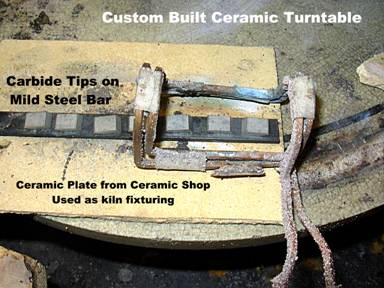
The picture illustrates two of our favorite techniques for increasing the number of carbide parts we can produce in a given time period.
The underlying plates are ceramic and thus do not react to the influence of the induction coil. (Note: this is not the best shape coil for this application but it does work very well for photography.)
1. Tungsten carbide has a cobalt binder so it is magnetically responsive and does heat up under an induction coil. However steel is roughly 10 times to 20 times as responsive as tungsten carbide. In the picture above we have tungsten carbide saw tips sitting on a mild steel bar. The mild steel bar gets hotter much faster than the saw tips do and helps to heat up the saw tips.
How to Braze Carbide Faster
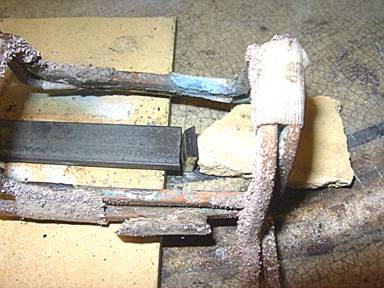
This is a setup to pretin saw tips. If we are going to pretin in this example we would put a piece of braze alloy wire with some black flux in the middle of the tips.
2. The tungsten carbide saw tips are arranged on a long, narrow piece of mild steel. The part of the mild steel underneath the coil heats up fastest. As the part under the coil heats the rest of the bar is also heating up. As the parts come to full temperature we move the bar in from the left to the right and the preheated carbide parts on the preheated steel bar braze even faster than the first parts did.
3. To get the fastest heating possible all parts of the coil should be as close to the actual braze joint as possible. As with light, the electromagnetic energy falls off with the square of the distance. If you double the distance between the coil and the part then you reduce the effectiveness by 75%. You want the coil as close to the work as possible. The only consideration is that you do not want the coil grounded out or shorted out.
Here is a very simple fixture. In this case we are brazing the carbide tip in the middle to the steel bar coming from the left. The carbide tip is wider than the steel bar. We want the carbide tip centered on the steel bar. You do a little math and figure out how far on each side the carbide will be wider than the steel. Then you lay the piece of steel on a ceramic plate so that the steel is raised up that amount above the ceramic plate on which the carbide sits.
On the right is just a broken piece of ceramic plate. This is to hold carbide saw tip in place during heating.
You can see another version of this technique in our Saw Blade brazing video.
The steel will heat up before the carbide. Once the steel, carbide and braze alloy are all up to temperature the braze alloy will flow onto the steel. You then turn the heat off and you will have a good part. Due to capillary attraction the carbide will tend to move towards the steel. This is a very minor effect. What is important is that the carbide will not move away from the steel.
Once the temperature has dropped enough that the braze alloy has hardened you may remove the assembly and let it finish cooling. Be very careful because the assembly can contain a great deal of residual heat and flesh burns can occur in this part of the operation.
The entire assembly should be allowed to cool until it is all room temperature. Accelerating the cooling process with cold water, for example, will seriously weaken the braze joint.
Torches
The above techniques are demonstrated with pictures from an induction brazing set up. The same techniques can also be used with a torch. In the case of a torch you would preheat by holding the torch on the right side of the picture and having the flames wash down the parts to the left.
Contact us to buy carbide and braze alloy
1 800 346-8274
Router Bits and Southeast Tool: Why We Love Them
Posted on Wednesday, September 21st, 2011 at 4:35 pm.
Jeremy Broun, who Woodworking Magazine called one of the most innovative craftsmen, and who has shown his work at such places as Souterbys and The Royal Society of Arts, wrote a book about his love of routers. In this book he called routers “the most versatile tool in the world.”
Of course every wood worker already knows this. Not only is a router a highly effective tool, but it’s also unique in its range of uses. It is a tool used for both a completely utilitarian use, and also for a completely aesthetic use. Often it accomplishes both at the same time.
There are two distinct markets for router bits. One is the large furniture makers and professionals who need to buy a great deal of durable, long lasting router bits by the hundreds. The other are the every day handymen and women who need a few or a few dozen. The furniture plant will cut more wood in a day than a hobbyist woodworker will cut in a lifetime.
One of the original goals of the web store was to make really top-end tools, such as these top of the line router bits, available to all consumers from hobbyist to manufacturing plants. Thanks to people like Chuck Hicks, that is actually going pretty well.
Chuck Hicks is president of Southeast Tool. Southeast Tool makes extremely good router bits. You may never have heard of them because their primary market is industrial. Their router bits are typically sold by top end sharpening shops.
The woodworking manufacturing industry is very competitive, both in price and performance. Every cut has to be clean and accurate every time. Southeast Tool does very well in this industry.
There is one problem. Southeast Tool does not spend a huge amount of money on magazine advertising as some other tool companies do. Instead Southeast Tool sells their quality tools for less money. So we like to ask the customer to try the tool.
Fortunately the tools are extremely good and, if we can get somebody to run them, then we always have a happy customer.
There is always hesitancy in getting people to try a new tool, especially one without a lot of advertising. This is why Carbide Processors has a 100% satisfaction guarantee on everything we sell.
So why do we love Southeast Tool? The same reason we love router bits. They’re versatile, reliable, and dependable.
We Buy And Sell Carbide!
Posted on Monday, September 19th, 2011 at 4:00 pm.
Heck, it’s right in our name!
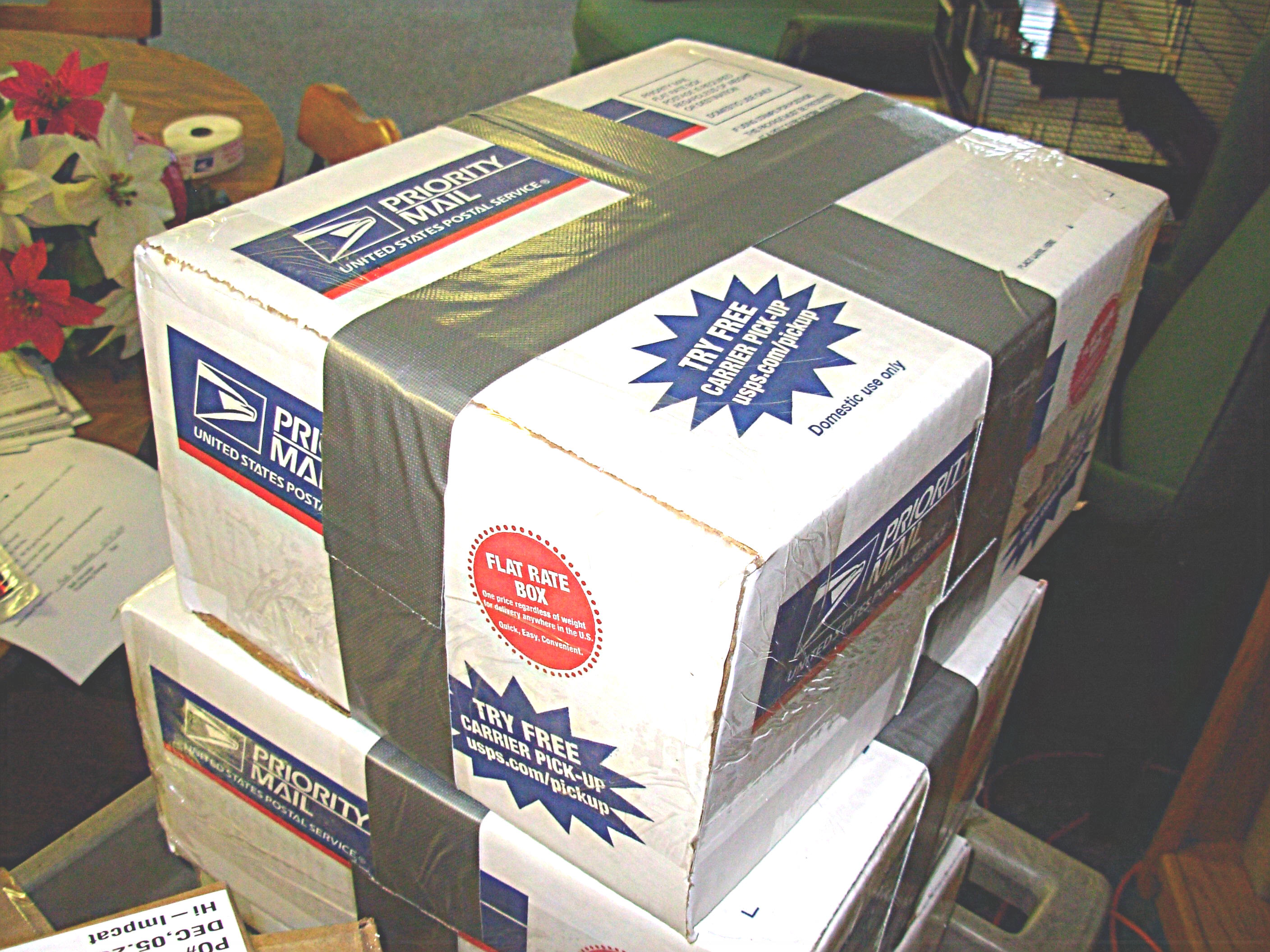
scrap carbide in USPS boxes for cheap shipping
We recently received 20 cases of carbide scrap from Universal Saw Company in California. These boxes were packaged like they were going to the moon. Mr. Nostrand used medium flat rate boxes that cost $10.85 each to ship.
He had about 30 pounds of carbide in each one. The packaging was beautifully done. He used some scrap hardboard or thin plywood top and bottom inside the box. The scrap carbide was double bagged in gallon Ziplocs. The whole thing was cushioned with crumpled paper which works a lot better than peanuts.
We received these 20 boxes and two more later. All 22 were in great shape inside. They were pretty beat up outside. The cardboard was scratched and crumpled, but the packaging was so well done that not a single tip was lost.
This was an expensive shipment and we were very grateful that Mr. Nostrand took the time to wrap them so well.
Speaking of carbide, many of you know that recent changes by one supplier in the carbide industry have caused a lot of disruption.
We get as many as several calls a day from people who are desperate to find carbide.
We saw this coming a year or so ago. We have greatly increased our carbide inventory here. We have worked with our suppliers to have them increase their inventory and to arrange for fast shipment to us or directly to our customers.
As always, we maintain a long list of carbide suppliers around the world.
We also buy carbide scrap for 8$ a pound or more. You can call us for a quote at 1800 346-8274. Just make sure you package well!
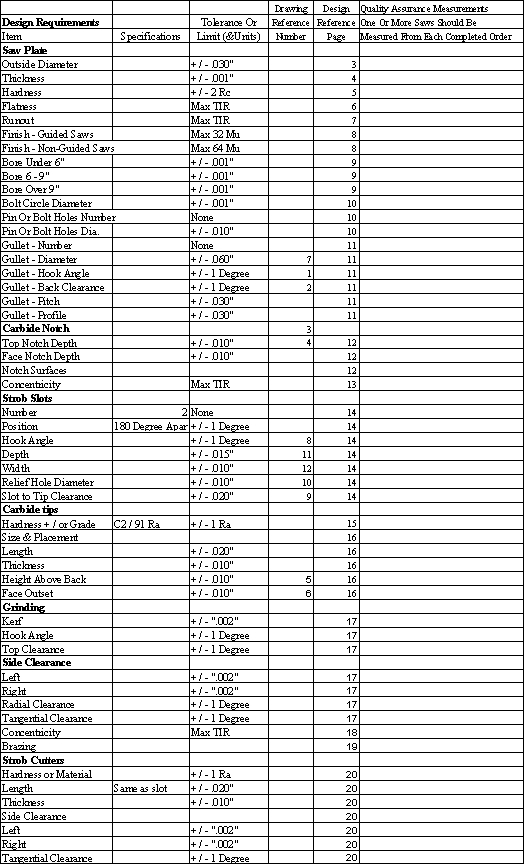
Carbide Saw Blade Specification Manual: Index of Design Requirements
Posted on Saturday, September 17th, 2011 at 7:09 pm.
Our final installment of Carbide Saw Blade Specification Manual!
Buy great custom saw blades
Buy Tenryu and Popular Tools saw blades
Carbide Saw Blade Specification Manual: P.21 Strobe Saws: Cutters
Posted on Saturday, September 17th, 2011 at 4:00 pm.
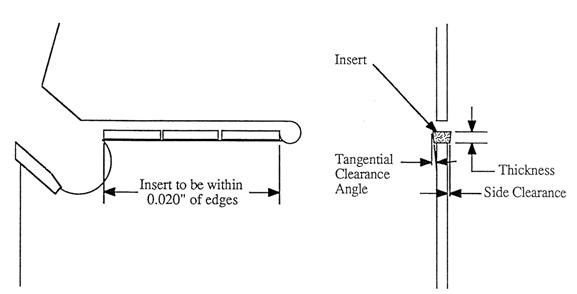
Strob Saws: Cutters
Specification
All design elements of the Strob slot shall be as specified, within the following tolerances:
Recommended Tolerance
• Material Stellite/Carbide
• Insert Hardness ± 1 Rockwell
• Width Kerf-0.010″ +0.000″ / -0.003″
• Thickness 1/8″ nominal before brazing
• Side Clearance Equal ± 0.002″
• Tangential Clearance 2 Degrees ± 1 Degree
Verification
- Hardness. Hardness testing requires a bench type instrument with a Rockwell “A” indenter and performed by qualified personnel. If equipment is not available, sample tips may be sent to a qualified testing facility, for evaluation.
- Width. Measure with a dial caliper.
- Thickness. Use a dial caliper
- Side Clearance. Use a side clearance gauge to check each insert, on each side, along its entire length.
- Tangential Clearance Angle. Use a 0-1″ micrometer with pointed anvils. – see angle equivalent table in appendix.
Carbide Saw Blade Specification Manual: P.20 Carbide Tips: Brazing
Posted on Friday, September 16th, 2011 at 2:00 pm.
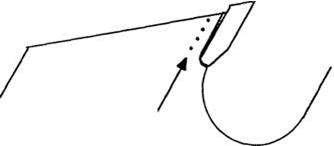
Hardness, Measurement Points
(1/8″ apart)
Specification
• Hardness adjacent to braze shall be ± 2 points of Rockwell “C” of the specified plate hardness.
• Braze shall cover the full area of contact between tip and notch.
• Solder shall be clean, smooth and bright, without cracks or porosity.
• Tips shall be centered on each notch, and square with the plate.
Verification
Use a X10 hand lens to inspect several joints.
Hardness must be tested with a reliable bench type Rockwell hardness tester.
Buy great custom saw blades
Buy Tenryu and Popular Tools saw blades
Carbide Saw Blade Specification Manual: P. 19 Carbide Tips: Grinding
Posted on Thursday, September 15th, 2011 at 2:36 pm.
Specification
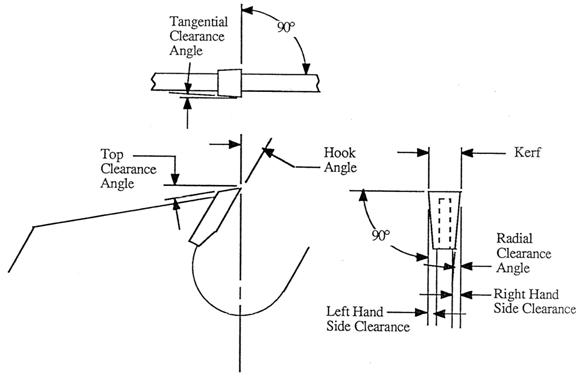
Grinding angles and tolerances shall be as listed below:
Recommended Angle Tolerance
• Kerf (tip width) +0.000″ / – 0.002″
• Hook Angle 30° +/- 1 Degree
• Top Clearance 8° +/- 1 Degree
• Radial Clearance 3° +/- 1 Degree
• Tangential Clearance 3° +/- 1 Degree
• Side Clearance (left or right) Equal +/- 0.0011,
Verification
- Kerf: Use standard 0-1″ “C” micrometer on several random tips.
- Hook and top clearance angles: Use a precision protractor on several random tips.
- Radial Clearance: Use a 0-1″ micrometer with pointed anvils. Measure several random tips – see angle equivalent table in appendix.
- Tangential Clearance: Use a 0-1″ micrometer with pointed anvils. Measure several random tips.
- Side Clearance: Use a side clearance gauge to check centering. Measure several random tips on each side.
Buy great custom saw blades
Buy Tenryu and Popular Tools saw blades
Safety Glasses That Are Totally Cool
Posted on Wednesday, September 14th, 2011 at 5:08 pm.

Dorky safety glasses
Safety Glasses That Are Totally Cool
We have manufacturers’ reps to call on us with new products. One of the best is a guy named Gary Tucker of Tucker sales.
So anyway, he is sitting here one day talking to the girls and he brings up the idea of us selling safety classes.
I told him that I didn’t like safety glasses. They always look bad. They are uncomfortable. Everybody already owns a couple pair and there’s just not any money in them.
So he says “Wait a minute” and goes out to his car. He comes back in with samples of the new Edge eyewear safety glasses.

Totally Cool Edge Eyewear safety glasses as worn by Gary Tucker
These things are just totally cool. They look like the stuff you see on TV on American Chopper or on extreme sports.
I always figured that those were just fashion and not really protection. The Edge eyewear people have done it right. Their glasses meet mil spec and ANSI specifications for safety.
Plus the glasses are just totally cool.
I have posted two pictures. One is me in the old dorky glasses. The other is Gary Tucker looking really good. Now, you may never be as good looking as Gary Tucker but you can look that cool in your edge eyewear safety glasses from Carbide Processors.
Buy Edge Eyewear
800 346-8274
How To Get Workers To Wear Safety Glasses
Posted on Tuesday, September 13th, 2011 at 4:30 pm.
In 2008 the Bureau of Labor Statistics reported that 27,450 eye injuries occurred in 2008. In 3 out of 5 of those cases the workers were not wearing eye protection. That’s a pretty staggering number. It’s not surprising that most occurred in the construction, repair, and manufacturing fields.
Now, I know safety isn’t something that’s fun to talk about. It’s scary and frustrating and sometimes redundant. Most managers and construction/manufacturing blogs will tell you that safety gear itself works great, but it is difficult to make workers use it consistently. They’ll also almost always list the same reasons: the lenses fog up or are too scratched up, the glasses are uncomfortable, and, number one on the list, that the glasses look stupid.
Recently, on the Plastics Training and Technology Blog Andy Routsis wrote, “Safety glasses are not a matter of preference…they are a matter of safety. People would be wearing safety glasses while shopping, driving, and watching TV if they were fun, interesting, or fashionable.” Well, Andy, I have good news. There is a company making safety glasses fun, interesting, and fashionable.
Edge Eyewear designs safety glasses and safety sunglasses with sleek, modern lines that look more like fashionable designer glasses than the older, mad scientist look, as illustrated below.

Of course, they pass the American National Standards Institutes highest test for safety. They’re also designed to sit more comfortably. The frames are made of flexible material that adjusts to your face instead of the other way around. They have an anti-fog, anti-scratch coating to keep vision clear. Oh, also did I mention they look awesome? In other words, Edge Eyewear identified the reasons people might not be excited about wearing safety gear and fixed it.
Edge Eyewear was also the first to create a polarized safety lens. Though it will take longer, UV light can be just as dangerous as a projectile to the eyes. If you spend a long time working outside, or move between bright outdoor light and working inside, it is important to protect your eyes from UV and visible light as well as sparks and debris.
Instead of trying to convince workers to make due with a product they don’t like, Edge Eyewear performed a feat of manufacturing magic. They created cool safety gear.
-Leslie
Saw Blade Tip Loss
Posted on Monday, September 12th, 2011 at 4:06 pm.
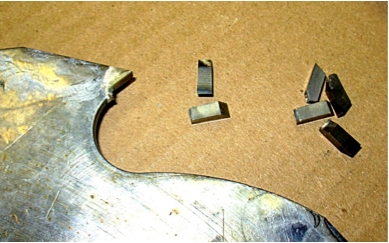
These tips had been plated to make them wet and braze well. The plating did wet and braze well but the plating did not stick to the tungsten carbide saw tip at all well.
This is entirely the fault of the manufacturer of the carbide saw tips and in no way reflects on the user.
Here are two pictures of representative notches in the steel saw body where the tips failed. Two features are significant here. At the left of either picture you can see where a small bit of carbide did adhere. On the rest of the notch you can see a sort of textured gray layer. This is the underside of the plating applied to the tungsten carbide. The braze alloy stuck to the steel and the plating stuck to the braze alloy and not to the tungsten carbide.
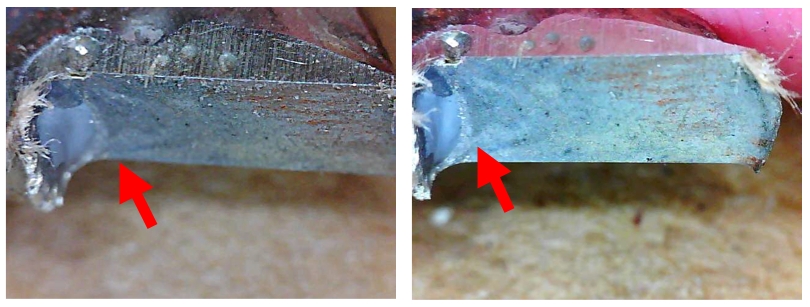
I took a small box knife and scratched one of the notches on the steel saw body. The plating came off readily exposing the gold layer of braze alloy underneath it.
You can see the same thing in the four pictures below. The top two pictures show two notches from the saw blade. You can see the gray layer the plating as well as little gold specks which is the braze alloy. The braze alloy held to the tungsten carbide wherever you see the gold spec. This may be as much is 1% of the total surface area but it appears to be much less.
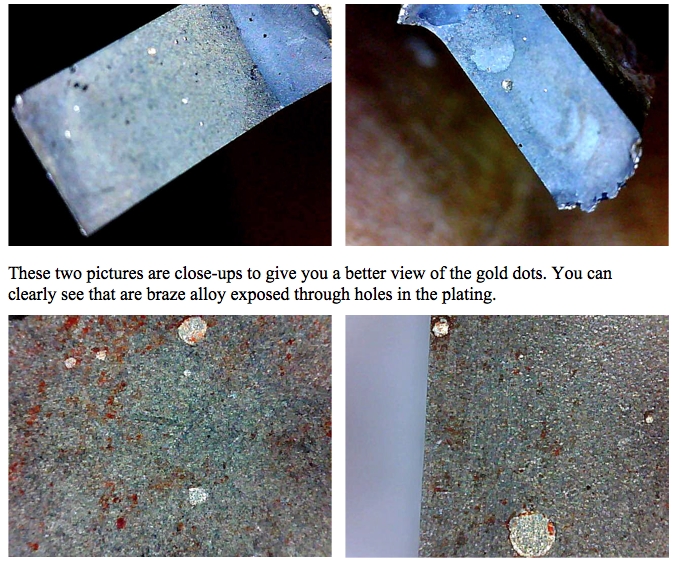
The Carbide failed in several places. In one instance that I saw the carbide actually snapped instead of having the surface plating peel off. The braze alloy was lifted off the tungsten carbide surface. If these tips had been properly prepared you would’ve seen nothing but ruptured carbide as in the four pictures above. This is a perfect example of manufacturer error that could have been prevented.
